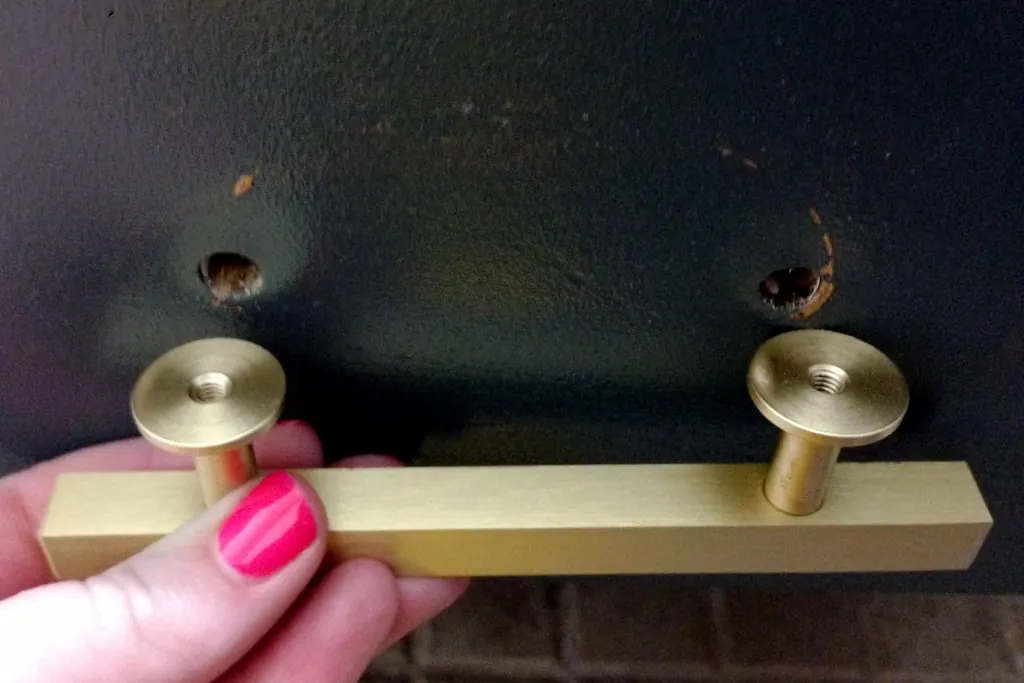
The coastal specification, which is the whole point of this page
In a San Clemente house near the water, the first cabinet component to fail is the hardware, not the timber, the finish or the box. That is the opposite of what people expect and it is worth understanding because the fix is a specification rather than a material upgrade, and it costs very little at the point the decision is made.
The mechanism is straightforward. Decorative plating on cheap hardware is a thin flash of chrome or nickel over steel, applied for appearance rather than protection. In salt-laden air, that plating pits, then blisters, then lets the steel beneath it corrode, and in a hinge or a slide the corrosion is mechanical as well as cosmetic: the moving parts stiffen and eventually seize. On a pull that gets handled with wet hands twice a day, it goes faster.
What survives is solid brass, stainless steel and zinc with a proper finish rather than a flash coating. None of those is exotic and none carries a large premium, and the difference only ever shows up years later, which is exactly why the decision gets made carelessly. It is also invisible in a quote unless somebody asks for it as a line.
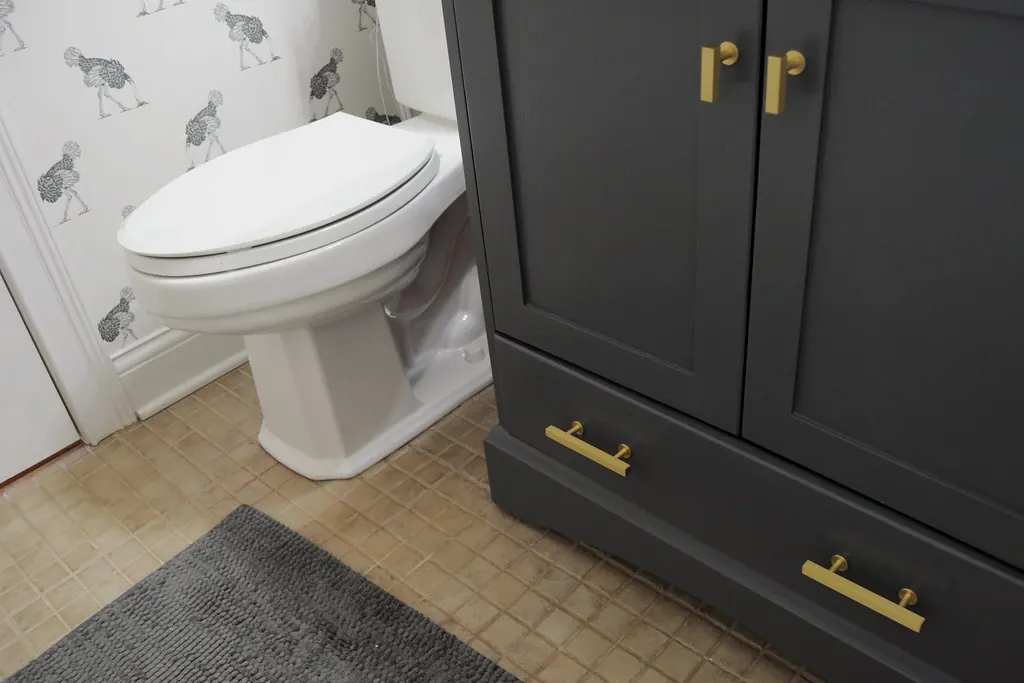
There is a published standard for cabinet hardware, and it tests for salt
Cabinet hardware has its own American National Standard, ANSI/BHMA A156.9, and one of the things it tests for is corrosion by salt spray. That is not a detail we are inflating for a coastal city. The Builders Hardware Manufacturers Association, the trade association that represents almost all North American builders hardware manufacturers and has maintained ANSI-approved standards for thirty five separate product categories since 1983, publishes a summary of the 2020 edition of A156.9 that names appearance as one of four evaluation areas and describes it this way: “Resistance to corrosion by salt spray testing is verified, providing confidence in the long-term appearance of the architectural metals and coatings.”
The standard is broader than most people expect. BHMA states that A156.9-2020 “contains requirements for cabinet hardware and includes hinges, knobs, pulls, catches, shelf rests, standards and brackets, drawer slides, rotating shelves and track with guides for sliding panels,” with “performance tests covering operational, cyclical, strength, and finish criteria,” and that it covers “requirements for nearly one hundred types of cabinet hardware.” So a shelf pin, a lazy Susan and a sliding panel track are all inside the same certification scheme as a hinge.
| Evaluation area | What BHMA says it covers | Published example figure |
|---|---|---|
| Types | Nearly one hundred types, including hinges, knobs, pulls, catches, shelf rests, standards and brackets, rotating shelves, and track with guides for sliding panels | No single figure; scope only |
| Durability | Cycle tests indicated by hardware type, to assure the design is capable of repeated operation without degradation | 100,000 cycles are required for a Grade 1 hinge |
| Strength | Static loads, torques and impacts depending on the function and type of hardware | Pulls shall support a 75 lbf test load without chipping, disassembly or breakage of the part or screws |
| Appearance | Resistance to corrosion by salt spray testing is verified | No single figure published in the summary; the test itself is the point |
Quoted from BHMA's own Hardware Highlights summary of ANSI/BHMA A156.9-2020, American National Standard for Cabinet Hardware. BHMA states plainly that the summary is not a substitute for the full standard.
Two of those figures are directly useful when you are standing in a showroom. A Grade 1 hinge is tested to 100,000 cycles, so if a kitchen door is opened and closed ten times a day that is a twenty seven year test, and a grade below that is a shorter one. A pull is tested to a 75 pound force static load without chipping, disassembly or breakage of the part or its screws, which is the number that explains why a pull fixed into a five millimetre door with short screws fails while the same pull fixed properly does not. The failure is rarely the pull.
The salt spray clause is the one that matters most in San Clemente, and it is worth being precise about what it does and does not tell you. It verifies that a certified product’s metal and coating resist corrosion under a defined test. It does not tell you that an uncertified product fails, and it does not grade coastal exposure. What it gives you is a question with a documented answer behind it: is this hardware certified to A156.9, and to what grade. BHMA publishes a certified product directory, so that is a question a supplier can answer rather than an opinion they can offer.
Hinges
A modern cabinet hinge is a cup hinge, bored into the back of the door and screwed to the carcass or the face frame, and it is specified by four things: the overlay it produces, the cup diameter, the boring position from the door edge, and the door thickness it is designed for. Those four together are why doors and hinges are chosen at the same time.
The consequence of getting it wrong is subtle rather than dramatic. A door bored for one manufacturer and hung on another’s hinge will often go on, but it will sit at the end of its adjustment range, which means the first time anything settles there is no correction left. Cabinet doors settle. That is why a good installation includes an adjustment visit after the room has been used for a while rather than only on the day.
Soft close, and the retrofit option
Soft-close hinges exist both as integrated units and as small retrofit dampers that clip onto an existing hinge arm. The retrofit version is one of the cheapest genuine improvements available to a kitchen that is otherwise fine, and it is worth knowing about before anybody quotes for replacing hardware that does not need replacing.
Drawer slides
Specify slides by extension, by load rating and by length, and treat them as three separate decisions. Extension is whether the drawer comes fully out or stops short: full extension is worth it on anything deep, because the back of a three-quarter extension drawer is a place things go to be forgotten. Load rating is a number that should appear on a quote. Length has to suit the carcass depth, because a slide longer than the box does not fit and a shorter one leaves dead space at the back.
| Drawer | Load | Duty cycle | What it needs |
|---|---|---|---|
| Cutlery and utensils | Light | Many times daily, partial opening | Standard slide, soft close is a comfort |
| Pot and pan drawer | Heavy | Daily, opened fully | Full extension, high stated load rating |
| File drawer | Very heavy | Opened fully every time | Full extension, high rating, filing rails |
| Bathroom vanity drawer | Light | Daily, damp environment | Corrosion-resistant finish matters more than rating |
Two drawers in the same kitchen can legitimately have different slides. A quote that specifies one slide for the whole job has either over-specified the light drawers or under-specified the heavy ones.
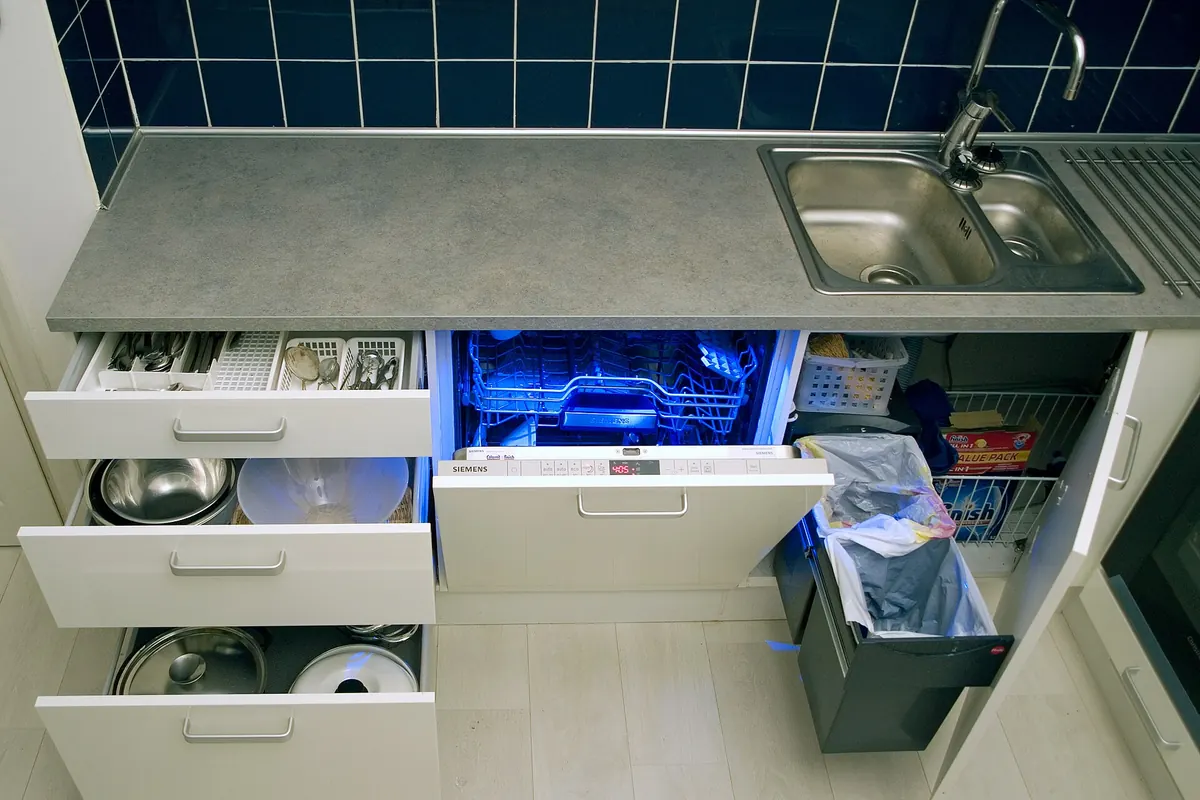
Pulls and knobs
The dimension that decides whether a pull fits is the centre-to-centre distance between its fixing holes, and it is the first thing to measure on an existing pull if you are hoping to swap without redrilling. If the new hole centres match the old ones, changing hardware is an afternoon. If they do not, the old holes have to be filled and the doors refinished, or hidden behind a backplate, and the job becomes finishing work.
On sizing, the usual correction people need is longer on drawers and shorter on doors. A wide drawer front with a single small knob in the middle gets pulled from one side more often than not, which racks the drawer in its slides over time; a long bar pull spreads that load and is a functional choice as much as a visual one. A door only needs enough pull to grip.
The practical method beats any rule: buy one or two candidates, hold them against your actual doors and drawers, and live with them for a day before ordering thirty. Hardware looks entirely different on a website from how it looks on a door at the scale of a real kitchen.
The interior fittings that are worth it
Beyond hinges, slides and pulls, a handful of interior fittings earn their cost and a larger number do not. The ones that consistently earn it are a bin pull-out, because it removes the worst object in a kitchen from the floor; drawer dividers for cutlery and utensils, because unsorted deep drawers become landfill; a corner solution of some kind, because the alternative is a cabinet nobody opens; and filing rails in a home office drawer.
The ones that frequently do not earn their cost are elaborate spice mechanisms, appliance lifts that nobody uses twice, and deep pull-out pantry units loaded beyond their slide rating. There is nothing wrong with any of them, but they are the line items to question first if a quote needs reducing, because removing them does not change the cabinetry.
Changing hardware on its own
New hardware on sound cabinets is the cheapest meaningful change available to a kitchen and it is frequently the right recommendation. It is also the natural companion to two other jobs on this site: if you are refacing, the doors are new so there are no old holes to deal with, and if you are painting, the doors are off and being finished anyway, which is the ideal moment to fill and redrill for different hole centres.
- Measure the centre-to-centre distance on an existing pull before shopping for new ones
- Ask for the slide extension and load rating to be stated on any quote, per drawer type
- Specify hinges at the same time as doors so the boring matches
- Choose solid brass, stainless or properly finished zinc anywhere near the water or in a garage
- Buy one or two candidate pulls and hold them against your own doors before ordering a full set
- Consider retrofit soft-close dampers before replacing hinges that are otherwise fine
- Put the bin pull-out on the list before any decorative mechanism
Everything hardware touches is on the custom cabinets page, the doors and fronts page covers overlay and boring in more detail, and the installation page covers the adjustment visit that good hardware still needs.