
Why an air quality rule is in a cabinet guide
Because it decides what can go through the spray gun, and the finish is the part of a cabinet you touch every day. Two published South Coast Air Quality Management District rules apply in San Clemente, and between them they explain several things homeowners find confusing: why professional cabinet finishing here is overwhelmingly waterborne, why a shop quote and a painter’s quote are built differently, and why a finisher from outside the district sometimes proposes a product a local one will not use.
San Clemente’s inclusion is not an inference. The district publishes a list of the incorporated cities within its four-county jurisdiction and San Clemente appears on it, in the Orange County column.
South Coast AQMD jurisdiction, with the city list→
Rule 1136, the shop rule
Rule 1136 was adopted on 16 September 1983 and has been amended many times since, most recently on 5 June 2026. Its stated purpose is “to reduce Volatile Organic Compounds (VOCs) and toxic emissions from the application of Coatings or Strippers to, and surface preparation of, any Wood Products.”
Its applicability clause is broad: the rule applies to anyone who “supplies, sells, offers for sale, markets, manufactures, blends, packages, repackages, possesses, or distributes any Wood Coating Materials, Wood Coating Materials components, Strippers, or associated solvent for use within the South Coast AQMD,” as well as any facility owner or operator who uses, applies or solicits the use of them. And it ends with the sentence that matters to homeowners: “This rule shall not apply to residential non-commercial operations.”
| Coating category | g/L coating | lb/gal | lb VOC per lb solids | Alt PW-MIR, g O3/g |
|---|---|---|---|---|
| Clear primers, sealers and undercoats | 275 | 2.3 | 0.36 | 0.53 |
| Pigmented primers, sealers and undercoats | 275 | 2.3 | 0.21 | 0.60 |
| Clear topcoats | 275 | 2.3 | 0.35 | 0.53 |
| Pigmented topcoats | 275 | 2.3 | 0.25 | 0.46 |
| High-solids stains | 350 | 2.9 | 0.42 | 1.87 |
| Fillers | 275 | 2.3 | 0.18 | n/a |
| Japans | 350 | 2.9 | 0.42 | n/a |
| Inks | 500 | 4.2 | 0.96 | n/a |
| Mold-seal coatings | 750 | 6.3 | 4.2 | n/a |
| Other coatings | 275 | 2.3 | 0.3 | n/a |
Quoted from Rule 1136 as amended 5 June 2026. Compliance may be demonstrated against the regulatory VOC limit, the pounds of VOC per pound of solids limit, or the alternative PW-MIR reactivity limit where applicable.
Low-solids coatings and strippers
| Category | g/L material | lb/gal | Composite vapour pressure limit | Alt PW-MIR |
|---|---|---|---|---|
| Low-solids stains, toners and washcoats | 120 | 1.0 | n/a | 1.03 |
| Low-solids barrier coat, plastic component | 120 | 1.0 | n/a | n/a |
| Strippers | 350 | 2.9 | 2 mmHg or less at 20 °C | 1.50 |
The stripper limit is directly relevant to cabinet refinishing, which is largely a stripping job. Rule 1136 also allows a facility to comply instead by using an approved Air Pollution Control System with the Executive Officer's written approval.
Rule 1136, Wood Products Coatings, full text→
Rule 1113, the on-site rule
Rule 1113, Architectural Coatings, was most recently amended 5 February 2016. It governs coatings applied to structures, which is what happens when a painter works on your fitted carcass faces rather than on doors in a booth.
| Coating category | Current limit, g/L |
|---|---|
| Wood Coatings, the heading category | 275 |
| Varnish | 275 |
| Sanding sealers | 275 |
| Lacquer | 275 |
| Wood conditioners | 100 |
| Stains | 100 |
| Stains, interior | 250 |
| Shellac, clear | 730 |
| Shellac, pigmented | 550 |
Rule 1113 also names "Wood Coatings, including Lacquers, Varnishes, and Sanding Sealers" as a category to which the small container exemption does not extend, so a small tin of lacquer is held to the same limit as a large one.
The two rules line up at 275 grams per litre on the main categories, which is convenient: a kitchen finished partly in a booth and partly in place is working to the same headline number in both places. The divergences are at the edges, particularly on stains, where Rule 1113 sets 100 for stains generally and 250 for interior stains, against Rule 1136’s 350 for high-solids stains in a shop.
Rule 1113, Architectural Coatings, full text→
What this means for the finish you actually get
Professional cabinet finishing inside this district is dominated by waterborne systems, principally waterborne conversion varnishes and two-component waterborne polyurethanes, plus waterborne alkyd-modified enamels for painted work. That is a direct consequence of the tables above rather than a stylistic preference.
The assumption that waterborne means inferior is roughly two decades out of date. Modern systems are hard, clear, non-yellowing and durable. What genuinely differs from old solvent lacquers is behaviour: flow, open time, recoat windows and cure profile. A finisher who sprays cabinets in this district every week has adapted to that; one who works mostly outside it may not have.
| Question | Why it matters |
|---|---|
| Which system, by name and type? | Conversion varnish, 2K polyurethane and alkyd-modified enamel behave differently in service |
| Sprayed in a booth or in place? | Decides which of the two rules applies and how even the film will be |
| How many coats, and is there a sealer? | A sealer under a clear coat is what stops the topcoat dragging the stain |
| What is the cure time before rehanging? | Dry to touch is not cured, and a soft film takes hinge marks permanently |
| Extra build at the handles and above the range? | Those are the two places a kitchen finish fails first |
None of these is an awkward question and all five have short answers from anybody who finishes cabinets regularly.
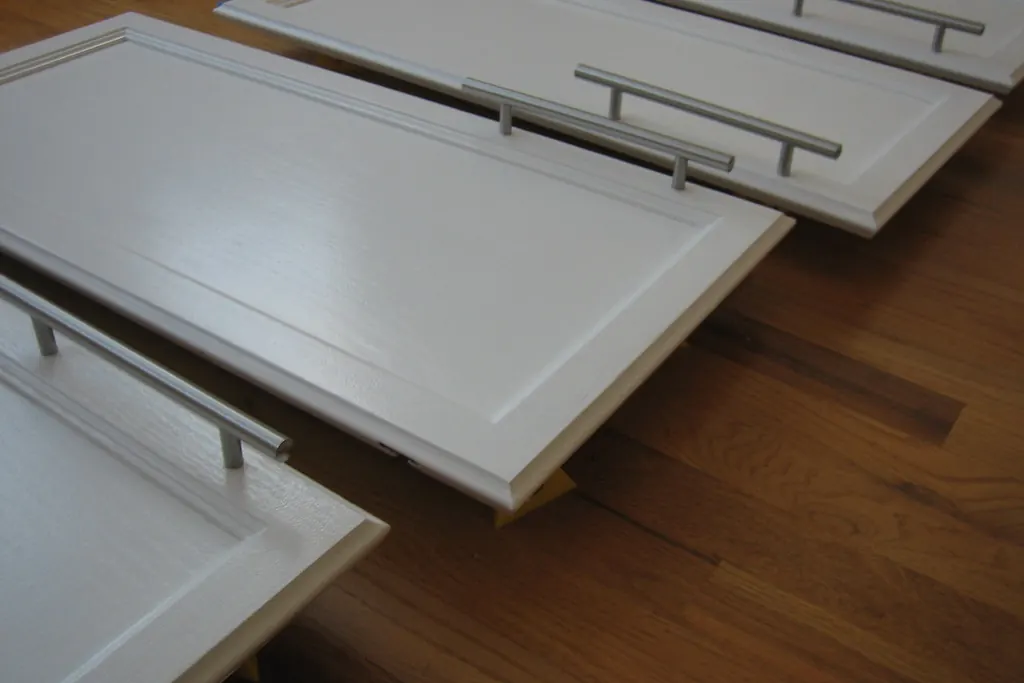
The part nobody regulates: preparation
No air district rule governs whether the surface was degreased properly, and that is the variable that decides whether a finish lasts. A kitchen cabinet face carries a film of cooking residue, heaviest around the range and above the extractor, and no primer bonds through grease. Stripping, filling, sanding to a consistent key and priming with a product matched to the substrate is the majority of the labour in a refinishing or painting job, and it is entirely invisible afterwards.
That combination, expensive and invisible, is why a quote dramatically below the others has almost always compressed preparation rather than found a cheaper coating. Ask how many hours are in a quote, not only what the total is.
The other half of the question: what the finish has to survive
Air quality rules cap what can go into a coating, and a separate published standard sets out what the cured coating has to withstand. ANSI/KCMA A161.1-2022 section 9 runs a finished door through a set of accelerated tests that are worth knowing about, because they describe the kitchen conditions a finish actually fails under, and none of them is the one people expect.
| Test | Conditions | Required result |
|---|---|---|
| 9.2 Shrinkage and heat resistance | 24 hours at 120 F and 70 percent relative humidity, after stabilising the door for 24 hours at room conditions | No discolouration, blistering or checking |
| 9.3 Hot and cold check resistance | Five cycles of one hour at 120 F and 70 percent humidity, half an hour at room conditions, then one hour at minus 5 F | No discolouration, blistering or checking |
| 9.4 Chemical resistance | One cc each of lemon, orange and grape juice, ketchup, coffee at 115 F, vinegar, olive oil, 100-proof alcohol and detergent solution left on the door, face frame, drawer front and drawer side for 24 hours; mustard for 1 hour | No stain, discolouration or whitening that ordinary polishing will not disperse |
| 9.5 Detergent and water resistance | The door edge stood in a trough of 0.5 percent dishwashing detergent solution on a cellulose sponge for 24 hours, or 4 hours where a splice or seam touches the sponge | No delamination or swelling, no discolouration, blistering, checking or whitening |
Quoted from ANSI/KCMA A161.1-2022 sections 9.2 to 9.5. Section 9.1 also requires that all finish tests be run on new surfaces only after the finish has aged a minimum of ten days.
Three of those four tests are about water and heat at an edge or a seam, not about the face of the door. That is the practical point. The detergent test deliberately gives an edgebanded or thermofoil door four hours where a solid painted door gets twenty four, because a seam is where a finish lets water in. In a coastal city, where the dishwasher door opens into steam and the sink run takes splashes all day, the edge and the seam are the parts to ask about, and the ten-day aging requirement in 9.1 is also the honest answer to why a freshly sprayed kitchen should not be scrubbed the week it is finished.
Where each service sits
| Job | Where the coating goes on | Governing rule |
|---|---|---|
| New cabinets, shop built | Doors, fronts and carcasses in a booth | Rule 1136 |
| Refacing | New doors and fronts in a booth; skins applied on site | Mostly 1136 |
| Refinishing | Doors stripped and finished in a shop; frames on site | Both |
| Painting existing cabinets | Doors in a booth if removed, frames in place | Both |
| Homeowner doing their own | Anywhere | Rule 1136 expressly excludes residential non-commercial operations |
The practical consequence for a client is simply to ask where each part of their kitchen is being finished, because that tells you what the film quality is likely to be as well as which rule applies.
What is deliberately not in this guide
No claim that a particular brand is compliant or non-compliant, because compliance is a formulation question that changes with product revisions. No claim about enforcement practice, because that is not published in a form worth quoting. And no VOC figure attributed to San Clemente specifically, because the rules are district-wide and there is no city-level variation to report.
- Ask which finish system is being used, by name and type
- Ask where doors are being sprayed and where carcass faces are being finished
- Ask for a sealer under any stained clear finish
- Ask for the cure time on the specific product and build it into the schedule
- Ask how degreasing is handled, especially around the range
- Ask for extra film build at the handles and above the cooking area
- If a proposal involves an unusually fast turnaround, ask what has been cut to achieve it
The services this guide underpins are cabinet painting and cabinet refinishing, and for new work, custom cabinets. The formaldehyde rules that govern the panels underneath the finish are a separate matter, covered in the box materials guide.