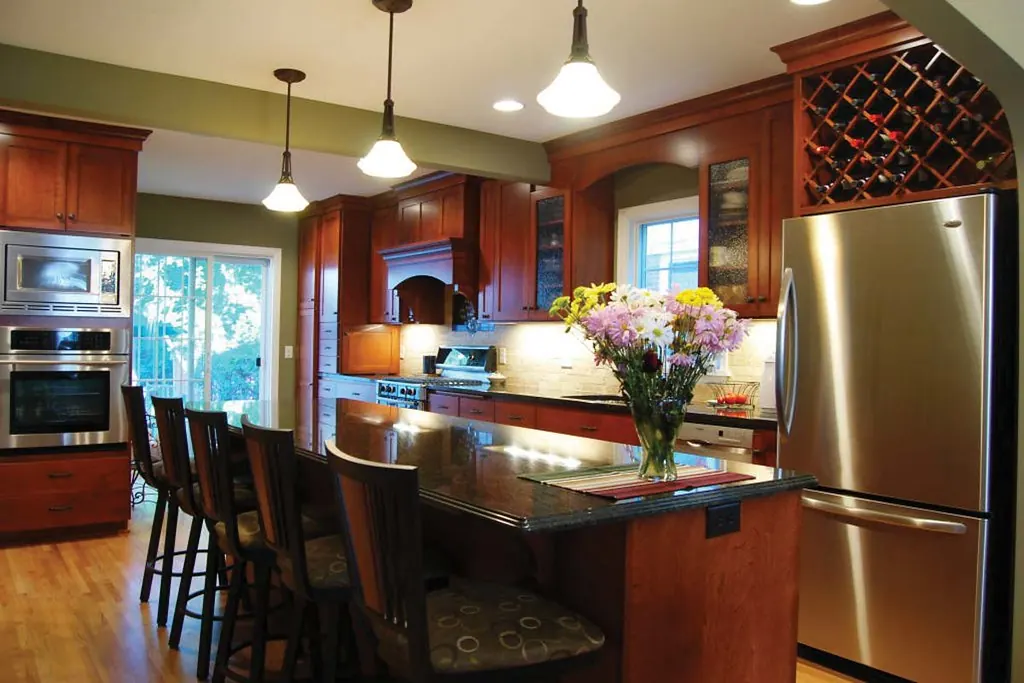
What refacing is, precisely
Refacing replaces every surface you can see and keeps everything you cannot. New doors, new drawer fronts, new exposed end panels, and a new veneer or laminate skin over the visible parts of the existing face frames, together with new hinges and usually new hardware. The carcasses, the shelves, the drawer boxes and the layout all stay exactly where they are.
That bargain is excellent value when the carcasses are good and worthless when they are not, which is why this page opens with a test rather than with a price. A great many San Clemente kitchens are in precisely the right condition for it: the 1980s and 1990s hillside developments in Rancho San Clemente, Forster Ranch and Marblehead Inland were built with decent cabinetry in layouts that still work, and what has dated is the raised panel profile, the arched valance over the sink and the colour. Those are surfaces.
What it costs in San Clemente
Published San Clemente refacing figures model laminate refacing of a standard twelve cabinet kitchen at $1,577 to $2,482, which works out at an average of $131 to $207 per cabinet. The breakdown behind that number is worth seeing, because it explains where the money goes and why the range is as wide as it is.
| Line | Quantity | Range |
|---|---|---|
| Refacing labour | 26.2 hours | $978 to $1,729 |
| Job materials and supplies | 12 cabinets | $546 to $683 |
| Equipment allowance | $53 to $71 | |
| Total | 12 cabinets | $1,577 to $2,482 |
| Average per cabinet | $131 to $207 |
These are modelled from labour-hour build-ups for San Clemente rather than collected from quotes, and the source describes them as an estimated cost breakdown. They are a planning band, not a price.
The same source puts real wood veneer refacing at roughly $2,000 to $6,000 and larger projects at $7,000 to $10,000, and lists hardware separately at $2 to $4 per knob or hinge at the budget end and $20 to $50 for premium pieces. A kitchen with thirty doors and drawers therefore has a hardware line of anywhere between about $60 and $1,500 depending entirely on what you choose, which is a bigger swing than most people expect.
Set that against replacement. Published custom cabinetry runs $500 to $1,200 per linear foot in California, with the Los Angeles band running to $1,500, so a 22 foot kitchen is in five figures for the cabinetry alone. Refacing the same kitchen is a low four-figure job in laminate. That gap is the entire reason the service exists, and it is why the condition of the boxes is worth five minutes of your attention.
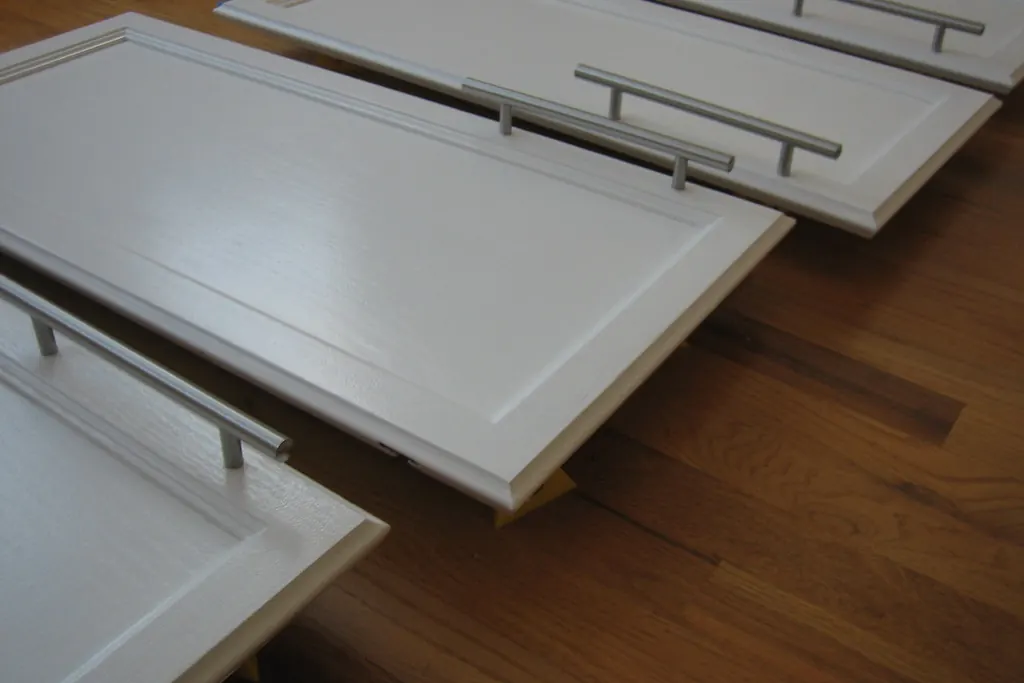
Laminate against real wood veneer
| Laminate and rigid thermofoil | Real wood veneer | |
|---|---|---|
| Published San Clemente cost | $1,577 to $2,482 on twelve cabinets | About $2,000 to $6,000 |
| Appearance | Consistent, printed or solid colour | Real grain, real depth |
| Can be stained later | No | Yes |
| Durability | Very good, hard wearing surface | Good, and repairable |
| Matching real timber elsewhere | Difficult | Possible, species for species |
The deciding question is usually whether anything else in the room is solid timber. If an island, a run of trim or an adjacent built-in is real wood, veneer matches it and laminate does not.
The six conditions that rule refacing out
Refacing keeps the boxes, which means it keeps every problem the boxes have. Six conditions make it the wrong service and all six are checkable in your own kitchen before anybody visits.
- A soft, dark or lifting sink base deck, which means a slow leak has already ended that carcass
- Face frames that have racked, so opening diagonals do not match and doors will not stay aligned
- Shelves that have permanently deflected under load and will not straighten
- A filler strip wider than about three inches, which is a layout fault a new door cannot fix
- A dead corner nobody can reach into, which refacing will reproduce exactly
- Doors where you actually want drawers, because converting them means rebuilding the box
If any of those describe your kitchen, the honest route is new cabinetry, and any contractor who quotes refacing over a failed sink base without mentioning it has not looked. If none of them describe your kitchen and the only complaint is the colour or the profile, refacing is very likely the right answer and a fraction of the alternative.
Pre-1978 houses: the rule that decides who may do this
Refacing strips existing doors and prepares existing face frames, which means it disturbs painted surfaces. In a house built before 1978 that brings the federal Renovation, Repair and Painting Rule into play, and the EPA administers that rule directly in California rather than through a state programme.
It requires that “Anyone who is paid to perform work that disturbs paint in housing and child-occupied facilities built before 1978 must be certified. This includes all firms, even sole proprietorships,” and it applies to “houses, apartments and child-occupied facilities (such as schools and child care centers) built before 1978.” Carpentry and painting preparation are both named among the covered activities.
The exemption is narrow: “Minor repair and maintenance activities that disturb six square feet or less of paint per room inside, or 20 square feet or less on the exterior,” and the EPA notes that “demolition of painted surfaces” is covered regardless of area. Removing a kitchen’s worth of painted doors and preparing the frames behind them does not stay inside six square feet.
San Clemente incorporated on 27 February 1928, and a large share of its 26,647 housing units predates 1978, including all of the mid-century tract belt. If your house is in that group, ask whether the firm holds EPA RRP certification before you compare prices, because a certified firm and an uncertified one are not offering the same thing.
What arrives, and whether it has been tested
Refacing replaces the doors and fronts, which means you are buying cabinet components from a manufacturer even though nobody is building a carcass. The same quality question applies as on a new kitchen, and there is a published way to ask it.
The Kitchen Cabinet Manufacturers Association’s ANSI/KCMA A161.1 certification covers “rigorous tests of their structural strength, drawer and door integrity, and finish durability.” Certified products have “passed 14 rigorous tests, including a 600-pound load test, to simulate a lifetime of use,” and the association reports that “Between 40% and 50% of cabinets fail their first certification attempt.” Certification is “available at every price point, from builder-grade units to high-end, custom designs.”
For a refacing job the door and drawer front integrity part of that is the relevant half, since the carcass is yours already. If the new doors are real wood or veneer, the formaldehyde rules also apply to any composite panel in them: California’s Green Building Standards Code sets maximum emissions of 0.05 parts per million for hardwood plywood, 0.09 for particleboard and 0.11 for medium density fiberboard, tested to ASTM E1333, and federal TSCA Title VI requires a compliance label.
Where the money actually goes, and what that tells you
The published San Clemente breakdown puts labour at roughly 62 to 70 percent of the total. That ratio is worth dwelling on because it inverts how people usually think about refacing, which is as a materials purchase with some fitting attached.
| Line | Range | Share of the total |
|---|---|---|
| Refacing labour, 26.2 hours | $978 to $1,729 | About 62% at the top of the range, 70% at the bottom |
| Job materials and supplies, 12 cabinets | $546 to $683 | About 27% to 35% |
| Equipment allowance | $53 to $71 | About 3% |
Shares are arithmetic on the published ranges for a standard twelve cabinet kitchen. Because labour dominates, the hours in a quote are more informative than the total.
Two practical consequences. First, a quote that is well below the others has almost certainly compressed hours rather than found cheaper skins, and the hours being compressed are cleaning, degreasing and preparing the face frames, which is precisely what decides whether the new skin stays bonded. Second, because labour dominates, scaling up does not scale the price proportionally in the way a materials-led job would: a kitchen with twenty cabinets rather than twelve is more hours, but the set-up, the equipment and the mobilisation are paid once either way.
Refacing against the other two renewal services
Three different services get quoted against each other and they are not the same job. Refinishing strips the existing coating off your existing doors and builds a new stained or clear finish on the original wood; the doors stay. Painting puts an opaque colour over the existing doors after preparation; the doors also stay. Refacing throws the doors away and fits new ones.
The practical test between them: if the existing door profile is what you dislike, only refacing helps, because the other two keep the profile. If the profile is fine and the colour is the problem, painting is far cheaper. If the profile is fine and the timber underneath is good but the clear finish has gone cloudy, refinishing keeps the wood visible in a way painting cannot. The three-way comparison guide sets all of it out with the published numbers side by side.
What changes and what does not
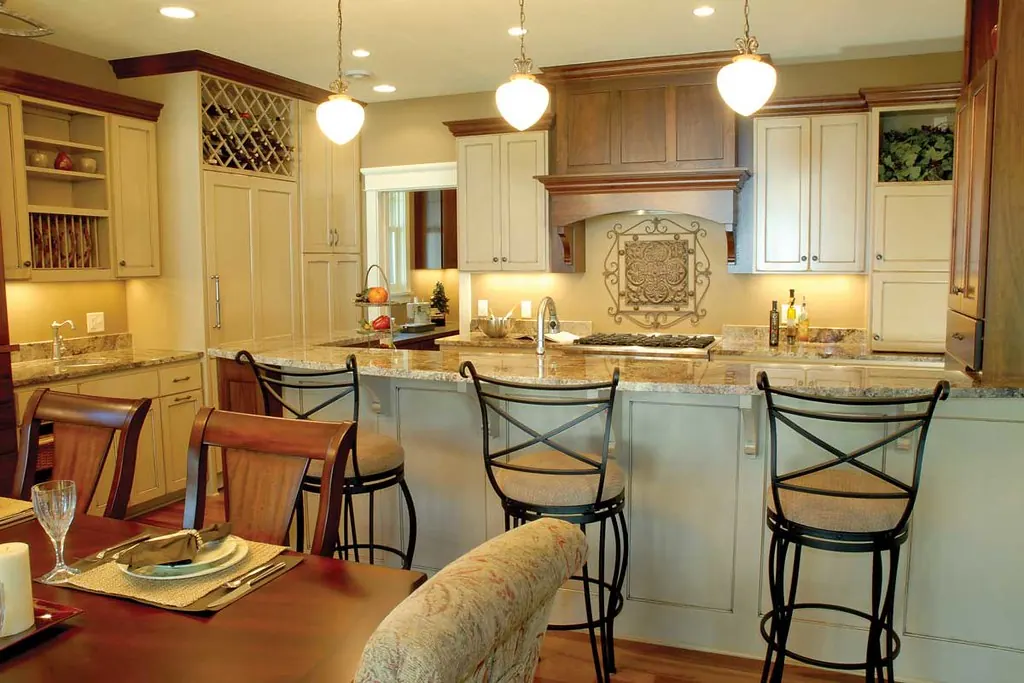
What you can change while refacing: the door style, the drawer front style, the colour and finish, the hardware, glass in selected doors, exposed end panels, and sometimes the interior fittings inside an existing box, such as a bin pull-out or drawer dividers.
What you cannot change: the position of any cabinet, the width of any cabinet, the location of fillers, the depth of the run, the existence of a dead corner, the size of an appliance opening, or a door cabinet into a drawer bank. Those are carcass decisions and they belong to a new kitchen.
One genuinely useful middle option exists: refacing plus one or two rebuilt cabinets. If the sink base has failed but everything else is sound, replacing that single carcass and refacing the rest is entirely possible and frequently the best value in the whole of this site. Ask for it explicitly, because it is not a standard package and nobody will offer it unprompted.
The lead rule in its exact regulatory words, because refacing is where it bites
Taking the doors off a painted pre-1978 kitchen is not minor work under the federal lead rule, and the regulation says so in a sentence most contractors have never read. The plain-English version of the exemption, the one that gets quoted everywhere, is minor repair and maintenance activities disturbing six square feet or less of paint per room inside. The regulatory version at 40 CFR 745.83 is longer and it is the longer version that decides a refacing job.
Read the third sentence again, because it is the one that settles refacing. When removing painted components, or portions of painted components, the entire surface area removed is the amount of painted surface disturbed. Refacing removes every door and every drawer front in the kitchen. If those are painted and the house predates 1978, the painted area disturbed is the whole area of every component removed, both faces, not the small patch anyone sanded. A single wall of upper and lower doors clears six square feet before the second wall is touched.
The last sentence closes the other door. Jobs performed in the same room within the same 30 days count as one job, so a reface cannot be staged into a series of small visits to stay under the threshold. And the first sentence is worth noticing for the opposite reason: the exemption expressly includes minor electrical and plumbing work, which is why a genuinely small repair can be exempt while a full reface of the same kitchen is not.
The practical consequence is a single question to ask any firm quoting a reface on a pre-1978 San Clemente house: are you an EPA lead-safe certified firm. The EPA administers the programme directly in California rather than through a state programme, so there is no state certification to point at instead. A firm that answers with a shrug is telling you it has not read 745.83.
How many San Clemente kitchens are actually refacing candidates
Roughly 13,100 San Clemente housing units were built between 1980 and 2009, which is the window where refacing usually beats replacement, and that is about 49 percent of the city’s entire housing stock. The SCAG Pre-Certified Local Housing Data prepared for the City’s 6th Cycle Housing Element Update, updated April 2021, records 26,573 total housing units and gives the distribution by year built, drawing on American Community Survey 2014-2018 five year estimates.
| Year built | Share of units | Approximate units | Refacing verdict |
|---|---|---|---|
| 1939 and earlier | 1.5 percent | about 400 | Rarely. Site-built casework, nothing square, and the lead rule applies to all of it |
| 1940 to 1969 | 25.6 percent | about 6,800 | Sometimes. Depends entirely on whether the face frames are still true |
| 1970 to 1979 | 21.7 percent | about 5,800 | Often, and the 1978 lead line runs through the middle of this band |
| 1980 to 1989 | 19.4 percent | about 5,200 | The best candidates. Sound boxes, dated fronts, no lead question |
| 1990 to 1999 | 10.8 percent | about 2,900 | Good candidates. Full overlay, hinge boring usually reusable |
| 2000 to 2009 | 19.2 percent | about 5,100 | Good candidates. Builder fronts are the weak point on a sound box |
| 2010 and later | 1.7 percent | about 450 | No. Too new for anything but a colour change |
Shares and the 26,573 unit total from the SCAG Pre-Certified Local Housing Data, updated April 2021, prepared for the City of San Clemente's 6th Cycle Housing Element Update, citing American Community Survey 2014-2018 five year estimates. Unit counts are the shares applied to the total and are rounded. The refacing verdicts are ours.
The 2000 to 2009 band is the one worth calling out, because at 19.2 percent it is nearly double the 10.1 percent regional figure and it is almost entirely the Talega, Forster Ranch and Marblehead builder stock. A twenty year old builder kitchen in one of those tracts typically has a perfectly sound plywood or particleboard box, a reusable hinge pattern and a door front that has either dated or failed at the edges. That is the textbook reface, and it is a much larger share of this city than it would be in most of Southern California.
Refacing in San Clemente specifically
The housing stock decides where this service fits. San Clemente’s 26,647 housing units span a century, and the City regulates seven Specific Plan areas from Pier Bowl through Rancho San Clemente and Forster Ranch to Talega. The 1980s and 1990s hillside areas are the natural refacing market: competent original cabinetry, layouts that work, and a stained raised panel look that has simply dated.
The oldest parts of the city, in Southwest San Clemente and North Beach, are usually the opposite. Where casework was built in place decades ago to non-standard openings, refacing is difficult and sometimes impossible, because there is no consistent overlay to work from and the carcasses have had a long time to move. And in the Talega-era housing, refacing rarely comes up at all, because nothing has dated yet. Coverage across all of it is on the service area page.