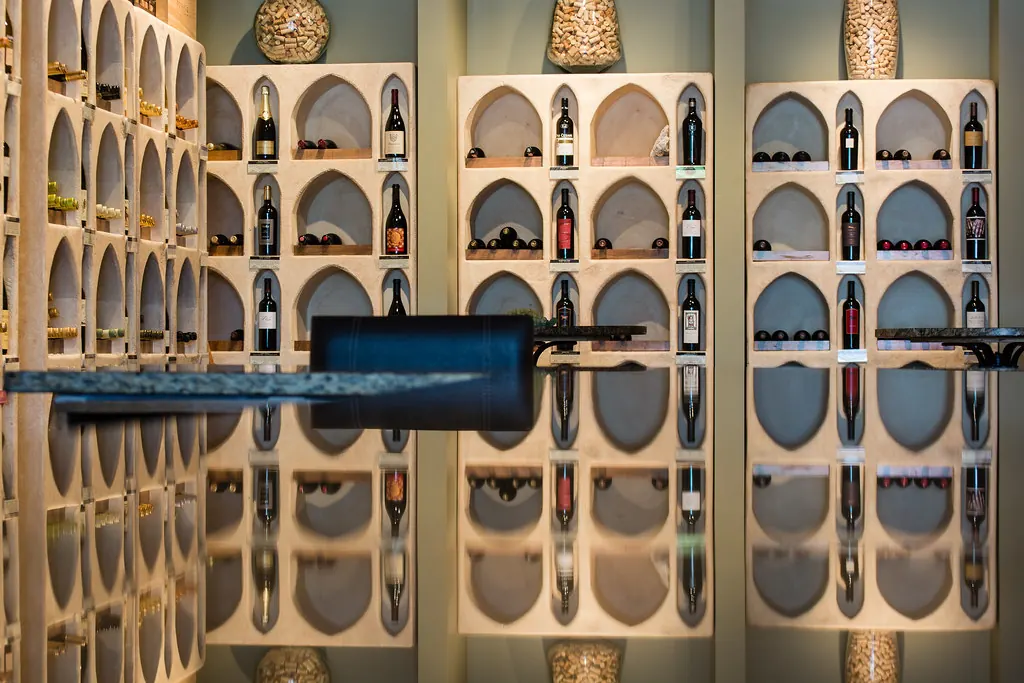
Storage or display, decided before anything is drawn
There are two entirely different jobs hiding behind the phrase “wine cabinet,” and choosing between them at the start saves both money and disappointment. The first is a bar run: somewhere to keep glasses, spirits, the bottles that are open and the two dozen that will be drunk this year. That is a joinery job, it is straightforward, and a cabinet does it perfectly well.
The second is long-term storage of bottles somebody intends to keep for years. That is not a joinery job. It is a temperature and humidity job with joinery built around it, and the cabinet is the least important part of the answer. Anybody who sells you a beautiful unconditioned cabinet as the solution to the second problem has sold you the solution to the first one.
The practical test is simple: if you can name the year you expect to drink the oldest bottle and it is within about twelve months, build a bar. If you cannot, or if the answer is measured in years, the design starts with a conditioned appliance or a conditioned space and the cabinetry follows it.
Why the location matters more than the cabinet
Heat and sunlight are what damage wine in a domestic setting, and both are decided by where the cabinet goes rather than by how it is made. A San Clemente house on a west-facing elevation gets a great deal of direct afternoon sun, and the wall behind a handsome bar cabinet in the best-lit corner of a dining room is exactly the wall that heats up.
Interior walls beat exterior ones. Hallways, the shaded side of a room and the interior wall of a dining room all outperform a west window. And anything next to a heat source, an oven, a refrigerator condenser, a dryer or a water heater, is a worse position than it looks, because the heat is continuous rather than occasional.
The garage deserves its own note because it is the most requested location and the worst one. A garage tracks the outdoor temperature and swings with it daily, and a San Clemente garage is likely to contain a water heater, a dryer and a warm car. If a garage is the only space available, the honest answer is a conditioned appliance sitting in the garage, not a rack fixed to the wall of it. The same logic applies to garage cabinetry generally, which is covered on the garage cabinets page.
The published numbers that decide whether you need a cabinet or a cellar
Wine wants 50 to 60 degrees Fahrenheit, held steady to within about 2 to 3 degrees, and that single sentence decides the whole project. Those figures are published, not folklore. Purdue University Extension’s Wine Storage Guidelines, written by enology professor Christian Butzke in the Commercial Winemaking Production Series, sets long-term storage at 10 to 16 degrees Celsius, names roughly 13 degrees Celsius as the traditional cellar temperature, and specifies that the temperature should be constant within plus or minus 1 to 1.5 degrees Celsius. Everything a wine cabinet page ought to tell you follows from comparing those numbers to the room the cabinet is going in.
| Exposure | Storage time | Temperature |
|---|---|---|
| Heat | Never | 30 °C (86 °F) or above |
| Heat | Spikes of 30 minutes or less | 29 °C (85 °F) or below |
| Heat | 1 to 4 weeks | 24 °C (75 °F) or below |
| Heat | Long-term storage | 10 to 16 °C (50 to 60 °F) |
| Cold | Never | minus 5 °C (23 °F) or below |
| Cold | Spikes of 30 minutes or less | 0 °C (32 °F) or below |
| Cold | 1 to 4 weeks | 10 °C (50 °F) or below |
| Cold | Long-term storage | 10 to 16 °C (50 to 60 °F) |
Reproduced from Table 1 of Purdue Extension publication FS-58-W, Wine Storage Guidelines, by Christian Butzke, Department of Food Science, Purdue University.
Read the table against a San Clemente living room and the answer is immediate. An interior room in this city sits in the seventies most of the year, which the table permits for one to four weeks and no longer. A garage in August can pass 85 degrees, which the table permits for thirty minutes. Nothing about that is a criticism of the cabinet. It is arithmetic about the room.
The reason stability is rated more tightly than the target is that the ageing reactions inside a bottle run at wildly different speeds. Purdue publishes the temperature rise that doubles each one: 3.8 degrees Celsius for oxygen uptake, 7.8 for browning, 16 for ethyl carbamate formation and 30 for the decline of sulfur dioxide in white wines. Because the four numbers are so far apart, warming a bottle does not fast forward it evenly. It accelerates oxidation four times more readily than it accelerates browning, which is why the publication states plainly that speed ageing by temperature alone will not produce a wine comparable to one aged at cellar temperature.
What a conditioned room actually requires, in construction terms
A conditioned wine room is an insulated, vapour-sealed box with a cooling unit, and the published specification is stricter than most homeowners expect. Vintage Cellars, a wine cellar company with a San Clemente address that publishes its own construction guidance, gives figures a builder can price. Its targets are a temperature of about 55 to 58 degrees Fahrenheit and humidity of 50 to 70 percent. Its construction requirements are a minimum of R-19 insulation in the ceiling, R-19 with a vapour barrier for an above-ground floor, one and a half inch rigid board for interior walls and three inch for exterior walls and the ceiling, and 6 or 8 mil plastic sheeting as a vapour barrier installed on the warm side of the insulation.
| Element | Published requirement | What it means on site |
|---|---|---|
| Temperature | About 55 to 58 °F | A cooling unit, not a cabinet, is doing this work |
| Humidity | 50 to 70 percent | Corks stay damp; a dry room dries the closure out |
| Ceiling insulation | Minimum R-19 | Deeper than a normal interior ceiling build-up |
| Above-grade floor | R-19 with a vapour barrier | A slab floor needs the barrier only |
| Interior walls | 1 1/2 inch rigid board | Or fibreglass in 2x4 and 2x6 framing |
| Exterior walls and ceiling | 3 inch rigid board | Exterior walls carry the larger load |
| Vapour barrier | 6 or 8 mil sheet, warm side | On the cellar side it condenses and wrecks the wall |
| Door | Exterior grade, 1 3/4 inch | With weather stripping and a bottom sweep |
| Glazed door | At least double-pane insulated tempered | Single pane sweats and runs the unit constantly |
| Floor finish | Never carpet | A concrete ground floor needs the vapour barrier only |
Figures read at source on Vintage Cellars' How To Build A Wine Cellar guidance page. We are quoting their published construction specification because it is the clearest one available for this climate, not as any form of endorsement.
The vapour barrier side is the detail that most often gets built wrong. Vintage Cellars states it directly: putting the barrier on the wine cellar side of the insulation will cause the humidity to condense on the barrier and could damage the walls. Purdue’s guidance reaches the same physics from the other direction, noting that moving bottles from very cold storage into a warmer environment condenses water on the bottle, labels and cork and can easily lead to mould growth and significant damage to the package. Both are the same warning about where warm, moist air meets a cold surface, and in a coastal city with high ambient humidity the warning is not academic.
Where that leaves the three real options
There are only three ways to store wine properly, and they differ by an order of magnitude in cost. A conditioned appliance is a purchased unit that arrives working, sits inside joinery, and needs a dedicated socket. A cabinet with a through-wall cooling unit is joinery built as a sealed, insulated compartment with a unit fitted to it, which means insulation, a vapour barrier and somewhere for the heat to be rejected to. A conditioned room is the full specification in the table above. In San Clemente, the first needs an electrical permit for the circuit, the second and third need electrical and mechanical permits for the unit, and the cabinetry itself stays exempt under the City’s own ordinance in all three cases.
| Route | What it conditions | What it commits you to |
|---|---|---|
| Conditioned appliance in joinery | The appliance interior only | A dedicated circuit, ventilation clearance, appliance replacement in a decade or two |
| Cabinet with a through-wall unit | One sealed cabinet compartment | Insulation, a vapour barrier on the warm side, heat rejection into another space, electrical and mechanical permits |
| Conditioned room | The whole room | R-19 ceiling, rigid board walls, 6 to 8 mil barrier, an exterior grade door, a sized cooling unit, and the permits that come with it |
The cabinetry is permit exempt in all three cases under San Clemente Municipal Code 17.04.032. The services attached to it are not.
Bottles are not one size
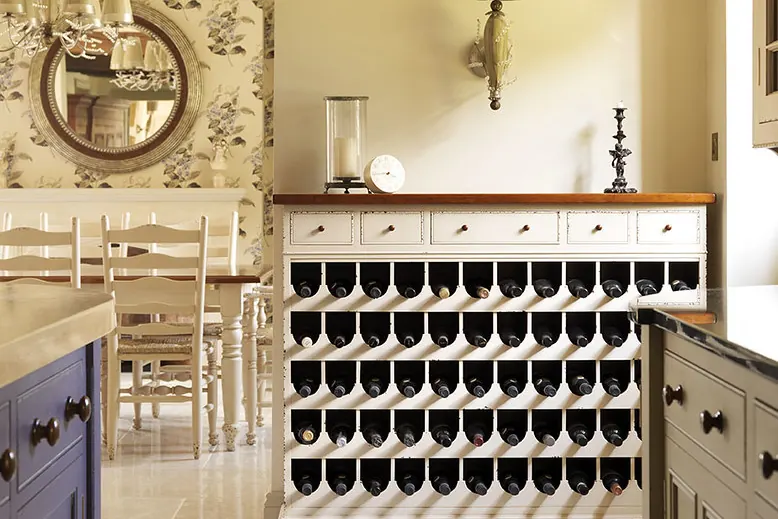
Measure the bottle mix in the collection before racking is drawn, because bottle shapes differ in both diameter and length and a rack sized for one shape will reject the others. This is the single most common wine cabinet mistake and it is entirely avoidable, because the information needed is sitting on a shelf in the house already.
| Variable | Why it matters | Design response |
|---|---|---|
| Diameter | A wider bottle will not enter a narrower cubby or cradle | Size to the widest common bottle, or build mixed bays |
| Length | A longer bottle projects past the rack face or fouls the back | Set rack depth from the longest bottle, not the average |
| Shoulder shape | Sloped shoulders sit differently in a cradle from square ones | Cradles and cubbies behave differently; cubbies are more tolerant |
| Magnums and large formats | Will not fit standard racking at all | A dedicated bay, sized separately, or accept they live elsewhere |
Individual cubbies are more tolerant of a mixed collection than a continuous cradle rack, which is why they are usually the better choice in a domestic bar.
Weight, and building for it
A full 750 millilitre bottle weighs about 1,300 grams, so a hundred-bottle wall is roughly 287 pounds of permanent static load before the cabinet is counted. That figure is published rather than estimated. The International Wine Challenge, setting out the Bottle Weight Accord signed by Lidl GB, Naked Wines UK, Virgin Wines, The Wine Society, Laithwaites, Waitrose, Whole Foods Market, Naked Wines USA and Systembolaget AB, records the current industry average for a 750 millilitre still wine bottle as 550 grams empty and about 1,300 grams full, with the Accord target being below 420 grams empty and 1,170 grams full. Systembolaget is reported as having already reached an average of 477 grams.
Put that against the published cabinet load standard and the problem becomes obvious. ANSI/KCMA A161.1 requires a mounted wall cabinet to carry 600 pounds up to 36 inches wide, and 800 pounds for a wall-hung base cabinet between 36 and 60 inches. At 1,300 grams a bottle, 600 pounds is about 209 full bottles. The shelf test in the same standard is a uniform 15 pounds per square foot held for seven days, and five full bottles resting on one square foot of shelf is already 14.4 pounds. A wine wall is therefore not a cabinet carrying a heavy load. It is a cabinet asked to spend its life at the number the standard tests it to once.
| Figure | Value | Source |
|---|---|---|
| 750 ml still wine bottle, empty, current average | 550 g | International Wine Challenge, Bottle Weight Accord |
| 750 ml still wine bottle, full, current average | about 1,300 g (about 2.87 lb) | International Wine Challenge, Bottle Weight Accord |
| Accord target, empty and full | below 420 g / 1,170 g | International Wine Challenge, Bottle Weight Accord |
| KCMA shelf and bottom static load test | 15 lb/ft² uniform, held 7 days | ANSI/KCMA A161.1-2022 §5.1 |
| KCMA mounted wall cabinet load, up to 36 in wide | 600 lb | ANSI/KCMA A161.1-2022 §5.2 |
| KCMA wall-hung base cabinet load, 36 to 60 in | 800 lb | ANSI/KCMA A161.1-2022 §5.2 |
| Full bottles equivalent to the 600 lb test load | about 209 bottles | Arithmetic on the two figures above |
| Full bottles that reach 15 lb/ft² on one shelf square foot | about 5 bottles | Arithmetic on the two figures above |
The KCMA deflection limit at that shelf load is 0.0625 inch per lineal foot between supports and 0.25 inch between any two supports, which is why a wine rack gets more frequent vertical support than a bookcase.
Wine racking is the heaviest thing per square foot in domestic cabinetry, and the load is static, concentrated and permanent. It never comes off, which is the part that distinguishes it from every other loaded cabinet in a house: a bookcase gets emptied when someone moves, and a wine wall does not.
Three things follow. The carcass is built for the load rather than adapted from shelving, with thicker material and more frequent vertical support than a bookcase would need. The unit is fixed into framing rather than into plasterboard, at every fixing point rather than at the convenient ones. And the floor matters: a hundred-bottle wall on an upstairs room in a timber-framed house is a different structural question from the same wall on a ground-floor slab, and it is worth raising at the survey rather than after installation.
Bottle orientation and light, which the cabinet does control
Cork-closed bottles go upside down or on their side, and that is one of the few wine variables a plain cabinet genuinely controls. Purdue Extension’s guidance is explicit that wine bottles closed with corks, both bark and synthetic, should be stored upside down or sideways to minimise gas exchange between the outside atmosphere and the wine inside and so avoid accelerated oxidation. That is a racking decision, not a refrigeration decision, which is why a well-designed unconditioned cabinet is still worth building properly rather than dismissing.
Light is the other one. Purdue frames its ageability figures as conditional on storage being provided without excessive ultraviolet exposure, and under that condition typical white table wines hold their quality for about three years after bottling while red table wines may hold or improve for three to ten. A solid door, or a cabinet sited away from a window, is doing real work against that condition. A glazed display cabinet facing a west elevation in San Clemente is working against it, which is the honest argument for putting the handsome unit somewhere other than the sunniest wall in the room.
Glass storage, which is the other half of a bar
Glasses want either a shelf deep enough to stand them upright without the rims touching anything, or a proper hanging rail that grips the foot. What does not work is a shallow shelf where glasses stand at the front and get knocked, or a hanging rail sized for one stem width used for a mixed collection. Stemware varies as much as bottles do.
The San Clemente second home, which changes the answer entirely
If the house stands empty for part of the year, an unconditioned wine cabinet is a worse idea here than almost anywhere, and San Clemente has an unusual number of houses like that. The SCAG Pre-Certified Local Housing Data prepared for the City’s 6th Cycle Housing Element records 26,573 total housing units with 24,337 occupied, an 8.4 percent total vacancy rate, and it breaks the vacant units down by category: 57.8 percent of them are seasonal, against 33.5 percent seasonal across the SCAG region as a whole. That is roughly 1,300 units in this city held as seasonal housing.
The practical consequence is straightforward. A house with the air conditioning off from October to May tracks outdoor temperature far more closely than a lived-in one, and Purdue’s table allows the range between 60 and 75 degrees for one to four weeks, not for a season. So on a second home the decision between a cabinet and a conditioned appliance moves decisively toward the appliance, even for a collection that would be perfectly safe in an occupied house. It is the one case where we will say plainly that the cheaper option is the wrong one.
The same data explains why the bar run is such a common request in this city rather than the wine room. San Clemente households are small: the SCAG figures give an average household size of 2.642 people, with two-person households the most common at 37.8 percent and one-person households second at 23.3 percent. A house entertaining a dozen people occasionally and two people habitually wants glass storage, a work surface and a modest bottle count within easy reach, which is a bar. The conditioned room is a different brief that arrives with a different question attached, and it is worth being clear which one you are asking for before anybody draws anything.
There is one more number in that dataset worth putting beside a bar quote. SCAG records San Clemente’s 2018 median home sales price for existing homes at $970,000, up 149 percent since 2000, and notes that prices here have run between 157.6 percent and 208.3 percent of the SCAG regional median over that period. In a housing market at roughly twice the regional median, a bar run is a normal item rather than an indulgent one, and it is also a market where a poorly built one is visible. That is the whole argument for spending the money on the carcass and the racking rather than on the frontage.
The bits of a bar that always get left out
A bar built as bottle racking plus glass shelving plus a counter ends up with everything else on the counter. The things that need a home and rarely get one: openers and foil cutters, cloths and bar towels, napkins and coasters, cocktail equipment, citrus and a board to cut it on, and bin space for corks and caps.
One shallow drawer solves most of it, and it is the highest-value square foot in the entire run. If the bar has a sink, add a bin pull-out, because a bar without somewhere to put waste becomes a place waste accumulates.
- Count the bottles you want to store and measure the widest and the longest of them
- Decide honestly whether this is storage for the year or storage for years
- Pick an interior wall away from west-facing glass and away from any heat source
- Check what is behind the wall, because a loaded wine wall fixes into framing at every point
- Include at least one shallow drawer for the things that are not bottles or glasses
- If a sink or ice maker is going in, budget for a plumbing and electrical permit alongside the cabinetry
- If it is going upstairs, raise the floor loading at the survey rather than after it is built
Butler’s pantries and bar runs in newer San Clemente houses
In the Talega and Marblehead Coastal Specific Plan areas, and generally in the newer end of San Clemente’s housing, the most common version of this job is a butler’s pantry or a bar run added beside an existing kitchen and matched to the builder’s cabinet package. That is a matching exercise: species, door profile, overlay and finish.
The first three reproduce exactly. The fourth does not, because a clear finish that has spent a decade in Southern California daylight has ambered, and a new one beside it reads as a near-miss. The two honest responses are to accept a deliberate contrast, which is a design decision rather than an apology, or to ask specifically how a shop intends to handle the aged finish. The good answers to that question are short and practical. The Talega page covers this pattern of work in more detail.
A note on timber and moisture, since it comes up
Wood in a bar cabinet behaves the way wood behaves anywhere else, which on this coast is unusually well. The USDA Forest Products Laboratory publishes monthly equilibrium moisture content for outdoor conditions by station, and the nearest one it lists to San Clemente is Los Angeles, whose year runs from 9.4 percent in January to 11.7 percent in June. That is a 2.3 point band across twelve months, which is mild. The chapter that data comes from is public: Wood Handbook chapter 13, Drying and Control of Moisture Content and Dimensional Changes →
The practical point is that timber movement is not the constraint on a wine or bar cabinet here. Load is, and temperature is. The species question is covered in the wood species guide, and everything shared with the rest of the cabinetry, including finishes and the paperwork, sits on the custom cabinets page. If the bar is going into a kitchen island rather than a wall, the islands page covers the structural and services side of that.