What refinishing does, and what it requires
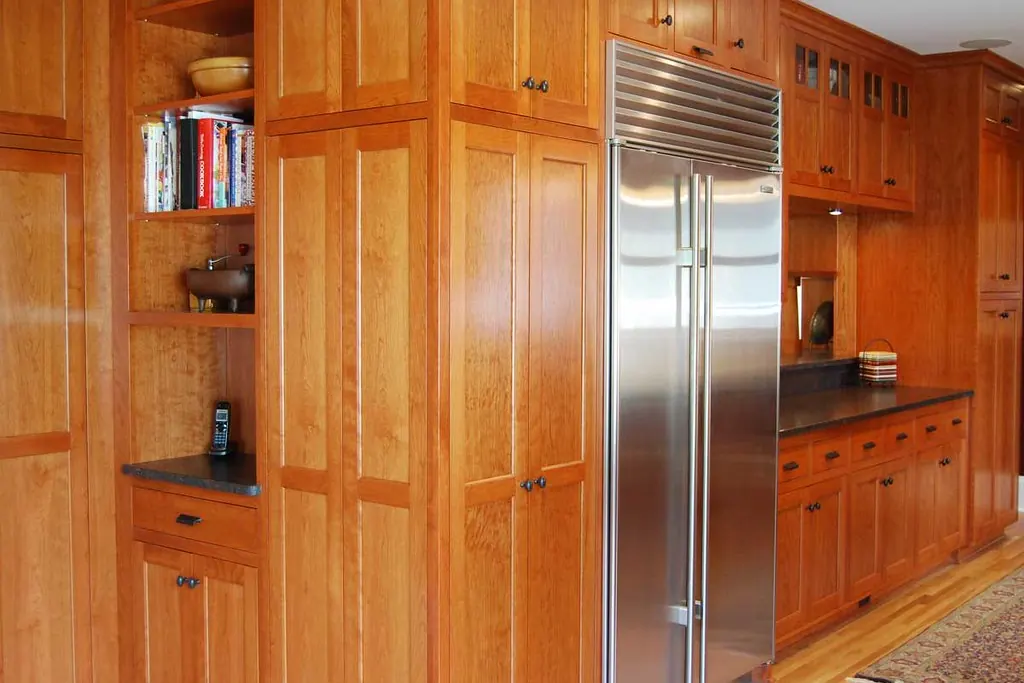
Refinishing removes the existing coating from your existing doors and builds a new transparent finish on the original timber, so the grain remains visible. It is the only one of the three renewal services that keeps a wood kitchen looking like wood. Painting covers the grain with opaque colour; refacing throws the doors away and fits new ones. Refinishing keeps the doors and keeps the timber.
It therefore has a hard prerequisite: there has to be real wood on the surface. Solid timber doors refinish beautifully. Wood veneer refinishes provided the veneer is thick enough to survive sanding, which most cabinet-grade veneer is but the thinnest is not. Printed foil, thermofoil, melamine and laminate cannot be refinished at all, because there is nothing under the coating to finish.
Preparation is the job
Stripping and sanding is where most of the labour in a refinishing job lives, and it is also the part nobody can see once the new finish is on. That combination, expensive and invisible, is the reason cheap refinishing fails and the reason a price that is dramatically below the others should prompt a question about preparation hours rather than a celebration.
The sequence is: remove and label every door and front by position, take off all hardware, strip the old coating chemically or mechanically or both, neutralise the surface if the stripper used requires it, sand to a consistent grit across every piece, and dust off thoroughly. Any coating left behind will show as a patch where the new stain takes differently, and any grit inconsistency will show as a patch where the new stain takes more deeply.
Labelling matters more than it sounds. A kitchen’s worth of stripped doors is a stack of nearly identical pieces, and they are not interchangeable: hinge boring, sizes and the way each one has worn differ. Doors that go back in the wrong openings produce a kitchen where nothing quite lines up and nobody can say why.
Stain, sealer and clear coats
The finish itself is built in layers rather than applied in one. Stain goes on and is wiped back to an even depth, which is where consistency across thirty doors is either achieved or lost. A sealer locks the stain down so subsequent coats do not disturb it. Then clear coats are built up, cut back between coats, and the final one is applied to the finished surface.
| Layer | Purpose | Where it goes wrong |
|---|---|---|
| Sanding to grit | Even absorbency across every piece | Inconsistent grit produces blotchy stain uptake |
| Stain | Colour, sitting in the grain | Uneven wipe-back produces patches that cannot be corrected later |
| Sealer | Locks the stain, stops later coats lifting it | Skipping it lets the clear coat drag the colour |
| Clear build coats | Film thickness, protection | Too few coats on a working kitchen wears through at the handles |
| Final clear coat | The surface you see and touch | Dust, insufficient cure time before rehanging |
The handles and the area above the range are where a kitchen finish fails first, because that is where hands and heat concentrate. Extra film build in those areas is cheap insurance.
The rules that govern what can be sprayed here
San Clemente sits inside the South Coast Air Quality Management District, which lists the city among the incorporated cities in its four-county jurisdiction. Two published rules therefore decide what a finisher can legally use, and which applies depends on where the work happens.
Rule 1113, Architectural Coatings, amended 5 February 2016, governs coatings applied on site. Its Table of Standards 1 sets, in grams of VOC per litre of coating less water and less exempt compounds: 275 for wood coatings generally, 275 for varnish, 275 for sanding sealers, 275 for lacquer, 250 for interior stains and 100 for wood conditioners and for stains generally. Clear shellac is allowed 730 and pigmented shellac 550.
Rule 1136, Wood Products Coatings, adopted 16 September 1983 and most recently amended 5 June 2026, governs shop application. Its Table 1 sets 275 grams per litre for clear and pigmented primers, sealers and undercoats and for clear and pigmented topcoats, 350 for high-solids stains, and 275 for fillers and other coatings. It also publishes a pounds-of-VOC-per-pound-of-solids column, which is the figure that decides how much film a coat can actually deliver: 0.36 for a clear primer, 0.21 for a pigmented one, 0.35 for a clear topcoat, 0.25 for a pigmented one. And its applicability section ends with a line worth knowing: “This rule shall not apply to residential non-commercial operations.”
The practical effect of both is that waterborne conversion varnishes and two-component waterborne polyurethanes dominate professional cabinet finishing in this district. They are not a compromise: modern waterborne systems are excellent. But they behave differently from old solvent lacquers in application and cure, which is why a finisher who works here every week produces better results than one who does not. The finishes and VOC rules guide quotes both tables in full.

Published San Clemente refinishing figures
There is San Clemente-specific published cost data for refinishing, and it is quoted differently from the refacing and painting figures, which is itself informative.
| Service | Published San Clemente figure | Unit |
|---|---|---|
| Cabinet refinishing | $1,077 to $5,991 typical | Whole project |
| Cabinet refinishing | $4 to $10 a square foot | Per square foot of cabinet surface |
| Cabinet painting | $1,035 to $5,758 typical | Whole project |
| Cabinet refacing, laminate | $1,577 to $2,482 on twelve cabinets | $131 to $207 per cabinet |
| Cabinet refacing, wood veneer | About $2,000 to $6,000 | Whole project |
All from the same San Clemente cost source, which models estimates from labour-hour build-ups rather than collecting quotes. Refinishing is the only one of the three quoted per square foot, which reflects that it is priced by surface area to be stripped rather than by cabinet count.
The per square foot figure is the useful one because it scales honestly. Cabinet surface area is not the same as kitchen floor area: it is the sum of the door and drawer front faces, both sides where doors are finished on both faces, the visible face frames and any exposed end panels. A kitchen with thirty doors and fronts has substantially more surface than a kitchen with eighteen, at the same linear footage.
Refinishing and painting land in almost exactly the same published band, $1,077 to $5,991 against $1,035 to $5,758. That is worth knowing before assuming refinishing is the expensive option: on most kitchens the two are close, and the choice between them is about whether you want to see the wood rather than about cost.
The lead rule, which applies with particular force here
Refinishing is a stripping and sanding job, which makes it the service on this site most squarely inside the federal Renovation, Repair and Painting Rule when the house predates 1978. The EPA administers that rule directly in California.
It requires that “Anyone who is paid to perform work that disturbs paint in housing and child-occupied facilities built before 1978 must be certified. This includes all firms, even sole proprietorships,” and it applies to “houses, apartments and child-occupied facilities (such as schools and child care centers) built before 1978.” Painting preparation is named among the covered activities.
The exemption covers “Minor repair and maintenance activities that disturb six square feet or less of paint per room inside,” with “demolition of painted surfaces” always covered regardless of area. Stripping a whole kitchen’s doors clears six square feet by an order of magnitude. The rule does not apply to housing built in 1978 or later, or to components “declared lead-free by a certified inspector or risk assessor.”
Strippers, and the limit that governs them
Stripping is the heart of refinishing, and the chemical strippers used are themselves regulated under the same South Coast AQMD rule that governs the coatings. Rule 1136’s Table 2, Table of Standards for Low-Solids Coatings and Strippers, sets an actual VOC limit of 350 grams per litre of materialfor strippers, with a composite vapour pressure limit of 2 mmHg or less at 20 °C and an alternative reactivity-based limit of 1.50 grams of ozone per gram of product. The same table sets 120 grams per litre for low-solids stains, toners and washcoats.
The practical consequence is that the aggressive solvent strippers people remember are not what a professional refinisher in this district is using. Compliant strippers work more slowly and need more dwell time, which is one more reason the preparation stage on a refinishing quote is measured in hours rather than in an afternoon, and why a quote that promises a very fast turnaround is worth questioning.
The full tables for both applicable rules are in the finishes and VOC rules guide.
What refinishing can and cannot change
Refinishing can change the stain colour, the sheen, and the condition of the surface. It can take a tired, cloudy, chalky finish back to something that looks new, and it can shift the colour within the range the timber allows.
It cannot change the door profile, the layout, the cabinet sizes or the hardware boring, and it has one specific colour limit worth naming: going substantially lighter. Stain can go darker easily. Going lighter depends entirely on how far stripping and sanding take the wood back, and on a red oak that has been dark-stained for thirty years the answer is often “not far.” That is the single most common point at which the honest recommendation becomes painting or new doors instead.
- Do a test patch first to confirm there is real wood under the coating
- Ask how many preparation hours are in the quote, because that is where the difference between quotes lives
- Ask whether doors are labelled by position before removal
- Decide the target colour and check it is achievable on your actual species, not on a sample board
- Ask for extra film build around the handles and above the range
- Confirm the finish system and that it complies with the applicable South Coast AQMD rule
- Allow proper cure time before rehanging, because a soft finish marks under a hinge
The three work practices the federal rule prohibits, and why sanding is the one
High-speed machine sanding of painted surfaces is prohibited on pre-1978 housing unless the machine is shrouded and fitted with a HEPA vacuum at the point of generation, and that single rule governs how refinishing is actually done in this city. It is not guidance. It is 40 CFR 745.85(a)(3), and the three prohibitions it contains are short enough to quote in full.
| Clause | The rule, quoted |
|---|---|
| (i) | “Open-flame burning or torching of painted surfaces is prohibited.” |
| (ii) | “The use of machines designed to remove paint or other surface coatings through high speed operation such as sanding, grinding, power planing, needle gun, abrasive blasting, or sandblasting, is prohibited on painted surfaces unless such machines have shrouds or containment systems and are equipped with a HEPA vacuum attachment to collect dust and debris at the point of generation. Machines must be operated so that no visible dust or release of air occurs outside the shroud or containment system.” |
| (iii) | “Operating a heat gun on painted surfaces is permitted only at temperatures below 1,100 degrees Fahrenheit.” |
Quoted from 40 CFR 745.85(a)(3). These apply to renovations in target housing, meaning housing built before 1978, and in child-occupied facilities. The same section requires at 745.85(a)(4) that renovation waste be contained to prevent releases of dust and debris before removal, that any chute used be covered, and that collected waste be stored under containment at the end of each working day.
Clause (ii) is the one that decides a refinishing quote. Refinishing means taking an existing finish back far enough to build a new one, and on a painted kitchen that means abrading a painted surface, which is precisely what the clause restricts. The compliant answer is a shrouded sander with HEPA extraction at the point of generation, operated so that no visible dust escapes the shroud. The non-compliant answer is an orbital sander and a shop vacuum, which is what a great many kitchens get.
Clause (iii) matters because heat is a legitimate stripping method on thick built-up paint and the rule does not forbid it, it caps it. Below 1,100 degrees Fahrenheit is permitted; above it is not, which rules out the old practice of running a gun as hot as it will go to lift a stubborn layer. Clause (i) rules out the blowtorch entirely. None of the three is a reason not to refinish. All three are reasons to ask what equipment is coming, and on a pre-1978 house they are the difference between a lawful job and an unlawful one.
How much of this city is old enough for the rule to apply
Just under half of San Clemente’s housing, 48.8 percent, was built before 1980, which makes the lead question a routine part of refinishing here rather than an exception. The SCAG Pre-Certified Local Housing Data prepared for the City’s 6th Cycle Housing Element Update, updated April 2021, records 26,573 total housing units and puts 1.5 percent in 1939 and earlier, 2.5 percent in 1940-1949, 7.9 percent in 1950-1959, 15.2 percent in 1960-1969 and 21.7 percent in 1970-1979, citing American Community Survey 2014-2018 five year estimates.
That pre-1980 half of the city is also, not coincidentally, where the timber kitchens are. Refinishing is a service for cabinets with a wood face worth exposing, and the eras that built stained oak, maple and birch fronts in this city are the 1960s and 1970s, which together account for 36.9 percent of the housing stock, about 9,800 units. The 1980-1989 band at 19.4 percent is a mixed picture where laminate faces begin to appear, and from 2000 onward the fronts are more often paint-grade or foil, at which point refinishing is the wrong service and the painting page is the right one.
The 1970 to 1979 band deserves one specific warning, because it is both the largest single band in the city at 21.7 percent and the one the 1978 line cuts through. A house built in 1972 is inside the rule and a house built in 1979 is outside it, and they can be on the same street in the same tract. The build date of the specific house is what matters, not the character of the neighbourhood, and it is worth establishing before a quote rather than after.
Which San Clemente kitchens are refinishing candidates
The strongest candidates are the stained timber kitchens of the 1980s and 1990s hillside developments, Rancho San Clemente, Forster Ranch and Marblehead Inland, where the cabinetry is real wood, the carcasses are sound, the layout works and what has gone is the clear coat. Those kitchens frequently do not need replacing at all, and being told so is a better outcome than being sold a kitchen.
The weakest candidates are anything with a foil or laminate surface, which rules out a large share of builder-grade cabinetry, and anything where the complaint is about profile or layout rather than finish. It is also worth checking the boxes before committing, using the same test as on the refacing page: refinishing beautiful doors on a failed sink base is the same mistake in a different material. If the boxes have gone, the route is new cabinetry, and the three-way comparison lays out all of it with the published numbers.