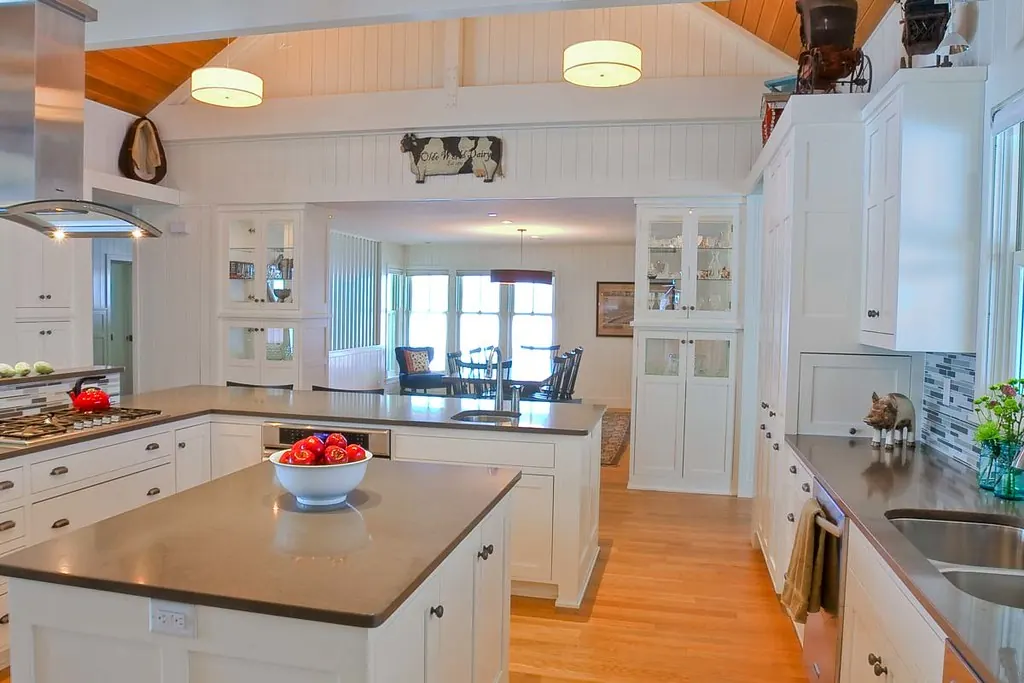
Painting is the cheapest change, when colour is the problem
Painting existing cabinets is the least expensive meaningful change available to a kitchen, and it is the right answer in exactly one situation: the boxes are sound, the layout works, the door profile is fine, and the colour is what you dislike. Change any one of those four conditions and something else on this site is the better service.
Published San Clemente figures give a typical painting range of $1,035 to $5,758, with an average around $1,000, materials up to $200 and labour around $70 to $120. Set that against published laminate refacing of a twelve cabinet kitchen at $1,577 to $2,482, or against custom replacement cabinetry at $500 to $1,200 per linear foot in California, and the case for painting is obvious whenever it genuinely applies.
The width of that published range, from about a thousand dollars to nearly six thousand, is not vagueness. It is two real variables. Door and drawer front count drives everything, because the job is priced per piece far more than per foot. And preparation drives the rest, because a twelve-door kitchen with a sound existing finish and a thirty-two-door kitchen with a failing coating and years of cooking residue are the same description and entirely different amounts of work.
Where the labour actually goes
Preparation is most of the job, and it is entirely invisible once the colour is on. That is the whole economics of cabinet painting and the reason quotes vary so widely for the same kitchen.
| Stage | What it does | What happens without it |
|---|---|---|
| Degreasing | Removes cooking residue from every face | Primer does not bond, and the film lifts in sheets |
| Filling and repair | Old hardware holes, dents, chipped edges | Every defect is visible through an opaque finish |
| Grain filling | Levels open-grain species for a smooth finish | Grain telegraphs through the colour |
| Sanding to a key | Consistent mechanical adhesion across all pieces | Patchy adhesion and uneven sheen |
| Substrate-specific primer | Bonds to what is actually there | A general-purpose primer on foil fails at the edges |
Degreasing is the one people skip and the one that matters most. Cabinet faces around a range carry a film of cooking residue that no primer bonds through, and the failure appears as paint lifting in clean sheets a year later.
Spray against brush
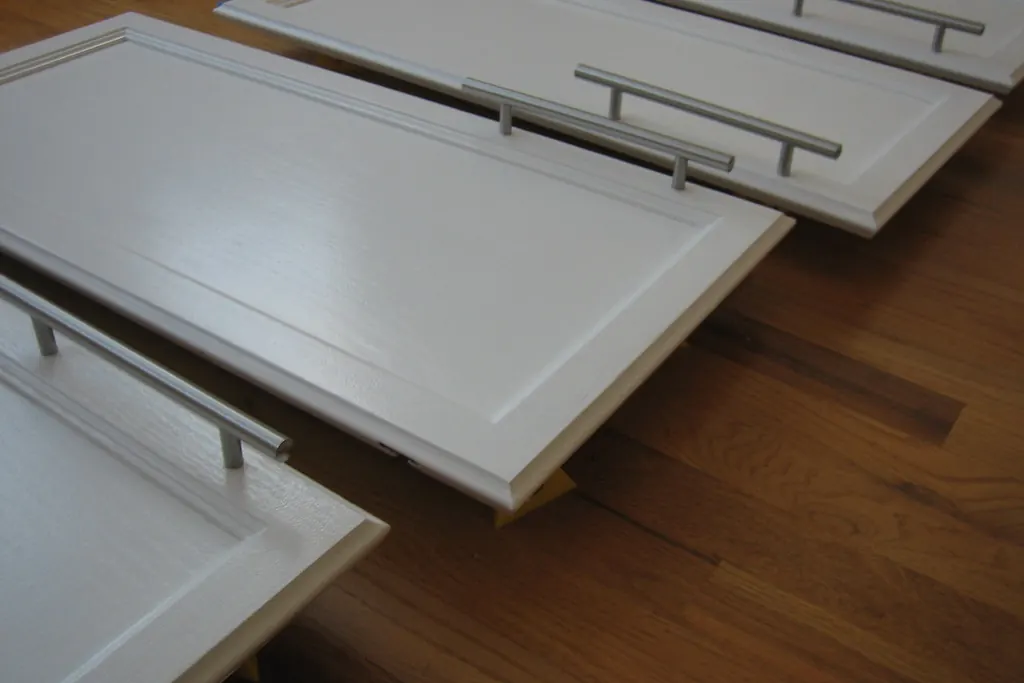
Doors and drawer fronts get sprayed, and that single decision is most of the difference between a professional cabinet paint job and a competent domestic one. A sprayed film laid flat has no brush marks, no roller texture, an even thickness and no runs at the edges, which is where brushed cabinet doors almost always fail because paint gathers on a vertical edge.
Carcass faces are more complicated, because they are fixed to a wall in a room full of things that must not be sprayed. Some painters mask thoroughly and spray in place, which gives the best match to the doors. Others brush and roll the frames with a fine finish roller, accepting a slightly different texture on a surface nobody looks at as closely. Both are legitimate; a good job may use both in the same kitchen and will tell you which.
The substrate changes the specification
Paint on solid timber, on MDF, on a previously painted surface and on foil or laminate are four different jobs sharing a name. MDF takes paint flatter than anything else, which is why painted doors are so often MDF to begin with. Open-grain hardwoods such as oak need grain filling first if a smooth finish is wanted, or the grain will read through the colour. Foil and laminate need a bonding primer specified for plastic films, and the honest note there is that adhesion, not the paint, is the limiting factor on durability.
The rules that govern cabinet coatings in San Clemente
San Clemente lies inside the South Coast Air Quality Management District, which lists the city among the incorporated cities within its four-county jurisdiction. Two rules apply and which one depends on where the spraying happens.
Rule 1113, Architectural Coatings, amended 5 February 2016, governs coatings applied on site. Its Table of Standards 1, expressed in grams of VOC per litre of coating less water and less exempt compounds, sets 275 for wood coatings, varnish, sanding sealers and lacquer, 250 for interior stains and 100 for wood conditioners. Rule 1136, Wood Products Coatings, adopted 16 September 1983 and amended 5 June 2026, governs shop application, setting 275 grams per litre for clear and pigmented primers, sealers and undercoats and for clear and pigmented topcoats, and 350 for high-solids stains. Rule 1136 also states expressly that it “shall not apply to residential non-commercial operations.”
What that means in practice is that professional cabinet painting here is dominated by waterborne systems, typically waterborne alkyd-modified enamels and two-component waterborne polyurethanes. Those are not a compromise. Modern waterborne cabinet enamels are genuinely hard-wearing. But they behave differently from old solvent products in flow, open time and cure, which is why a painter who sprays cabinets in this district every week gets better results than one who does not. The finishes and VOC guide quotes both rule tables in full.

The lead rule, which decides who may legally do this work
Cabinet painting in a house built before 1978 is regulated work, and in California it is the federal EPA that administers the rule rather than a state agency. This is the most consequential thing on this page and it is almost never mentioned by painters.
The Renovation, Repair and Painting Rule applies to “houses, apartments and child-occupied facilities (such as schools and child care centers) built before 1978,” and it requires that “Anyone who is paid to perform work that disturbs paint in housing and child-occupied facilities built before 1978 must be certified. This includes all firms, even sole proprietorships.” Its list of covered activities names painting preparation explicitly, alongside remodeling, carpentry, plumbing and electrical work.
The rule does not apply to housing built in 1978 or later, to zero-bedroom dwellings, to elderly or disabled housing where no child under six resides, or to “Housing or components declared lead-free by a certified inspector or risk assessor.” On testing, the EPA lists three routes and who may use each: EPA-recognised test kits by certified renovators, X-ray fluorescence instruments by certified lead-based paint inspectors or risk assessors, and paint chip sampling by any of the three. Testing is not itself required, but without documentation that the paint is not lead-based the rule’s requirements apply.
California is not among the states with an authorised state programme, so the EPA runs this directly here. For San Clemente the relevance is high: the city was incorporated on 27 February 1928, its oldest neighbourhoods in Southwest San Clemente and North Beach are nearly a century old, and the bulk of the mid-century tract belt also predates 1978.
The VOC tables in full, for both places a coating is applied
Section five explained which rule applies where. Here are both sets of numbers, because a painter working on your kitchen is working to one of them and the doors going to a booth are working to the other.
| Category | Limit, g/L |
|---|---|
| Wood coatings | 275 |
| Varnish | 275 |
| Sanding sealers | 275 |
| Lacquer | 275 |
| Stains, interior | 250 |
| Stains | 100 |
| Wood conditioners | 100 |
| Shellac, clear | 730 |
| Shellac, pigmented | 550 |
Grams of VOC per litre of coating, less water and less exempt compounds. Rule 1113 also names wood coatings including lacquers, varnishes and sanding sealers as a category to which the small container exemption does not extend.
| Category | g/L coating | lb VOC per lb solids |
|---|---|---|
| Clear primers, sealers, undercoats | 275 | 0.36 |
| Pigmented primers, sealers, undercoats | 275 | 0.21 |
| Clear topcoats | 275 | 0.35 |
| Pigmented topcoats | 275 | 0.25 |
| High-solids stains | 350 | 0.42 |
| Fillers | 275 | 0.18 |
| Other coatings | 275 | 0.3 |
| Strippers, from Table 2 | 350 g/L material | n/a |
Rule 1136's applicability section states that it "shall not apply to residential non-commercial operations," which is why a homeowner's own materials are not governed the same way as a contractor's.
For painted work specifically, the pounds-of-VOC-per-pound-of-solids column is the one that shapes the job. A pigmented primer is held to 0.21 and a pigmented topcoat to 0.25, tighter than their clear equivalents, which pushes formulations towards high solids and is part of why modern waterborne cabinet enamels build a usable film in fewer coats than their solvent predecessors did.
Cure time, which is where good jobs get ruined
Allow the finish to harden before the kitchen goes back into service, and treat that as part of the schedule rather than as advice. A cabinet coating that is dry to the touch has not finished hardening, and the two things that mark a soft film are hinges bearing on a door edge and doors stacked or leaned against each other.
The consequences are permanent and cosmetic: hinge-shaped impressions on the door edge, shiny patches where something rested, and fingerprints in the sheen around the handles. None of it can be polished out. Ask what the specific product’s cure time is, plan around it, and if a quote promises a turnaround that does not leave room for it, that is the question to ask.
Why a painting job cannot be split into small stages
Painting a kitchen in three visits does not make it three small jobs under the federal lead rule, because the regulation aggregates work in the same room over 30 days. That is written into the definition at 40 CFR 745.83: “Jobs, other than emergency renovations, performed in the same room within the same 30 days must be considered the same job for the purpose of determining whether the job is a minor repair and maintenance activity.” It exists precisely to stop the arithmetic being gamed, and cabinet painting is one of the trades where the temptation is obvious.
The same definition closes the other route. “When removing painted components, or portions of painted components, the entire surface area removed is the amount of painted surface disturbed.” Cabinet painting almost always means taking the doors and drawer fronts off to spray them flat, and on a painted pre-1978 kitchen the area counted is the whole area of every component removed rather than the part that was sanded. Between those two sentences there is no version of painting a whole pre-1978 kitchen that stays inside the minor repair exemption.
| Condition in 40 CFR 745.83 | Effect on a cabinet painting job |
|---|---|
| Disrupts 6 square feet or less of painted surface per room inside | A kitchen's worth of doors and fronts passes this on the first wall |
| None of the practices prohibited or restricted by 745.85(a)(3) are used | Unshrouded high-speed sanding removes the exemption regardless of area |
| Does not involve window replacement or demolition of painted surface areas | Stripping painted cabinets is demolition of painted surface areas |
| Jobs in the same room within 30 days count as one job | Staging the work across visits does not reduce the area |
Quoted and paraphrased from the definition of minor repair and maintenance activities at 40 CFR 745.83. The EPA administers the Renovation, Repair and Painting programme directly in California, which is not among the states authorised to run their own programme.
The honest reading of that table is not that painting a pre-1978 kitchen is difficult. It is that the job has a certification requirement attached to it, and the requirement falls on the firm rather than on you. A lead-safe certified firm plans containment, uses shrouded extraction and cleans to the rule as a matter of routine, and it costs what it costs. The problem is the quote that is cheaper because none of that is happening, which is the quote that looks best on paper.
Which San Clemente kitchens are painting candidates, in published numbers
The largest single pool of painting work in San Clemente is the 2000 to 2009 builder stock, which accounts for 19.2 percent of the city’s housing against 10.1 percent across the SCAG region. The SCAG Pre-Certified Local Housing Data prepared for the City’s 6th Cycle Housing Element Update, updated April 2021, records 26,573 total housing units and that 19.2 percent share, which is roughly 5,100 homes, citing American Community Survey 2014-2018 five year estimates. Those are the Talega, Forster Ranch and Marblehead tracts, and their kitchens have three things in common that make painting the right service rather than refinishing or refacing.
They are paint-grade or already painted, so there is no wood face worth exposing. They are between fifteen and twenty five years old, so the boxes and the hinge patterns are sound and nothing structural is being asked of the job. And they were built after 1978, which takes the federal lead rule out of the picture entirely and removes both the certification requirement and the cost that comes with it. A painting quote on a 2004 Talega kitchen and a painting quote on a 1968 Riviera district kitchen are different quotes for reasons that have nothing to do with the paint.
| Era | Share of units | Lead rule | Usual best service |
|---|---|---|---|
| 1939 to 1979 | 48.8 percent | Applies to all of it | Refinishing if the face is timber, painting if it has been overpainted |
| 1980 to 1989 | 19.4 percent | Does not apply | Refacing on a sound box, painting if only the colour is wrong |
| 1990 to 1999 | 10.8 percent | Does not apply | Painting or refacing; hinge boring is usually reusable |
| 2000 to 2009 | 19.2 percent | Does not apply | Painting. The largest painting pool in the city |
| 2010 and later | 1.7 percent | Does not apply | Painting only if the colour is genuinely wrong |
Era shares from the SCAG dataset above. The service recommendations are ours and describe the usual case rather than a rule; condition decides every individual kitchen.
Painting against the other two renewal services
The three-way choice is decided by what you dislike. Refinishing keeps the wood visible and is the only option if you want a timber kitchen to look like timber, but it cannot go dramatically lighter and it requires real wood on the surface. Refacing is the only one of the three that changes the door profile, because it replaces the doors. Painting is the cheapest and changes colour only.
- Confirm the boxes are sound before spending anything on the surfaces
- Count your doors and drawer fronts, because the job is priced per piece
- Ask specifically how degreasing is handled, especially around the range
- Ask whether doors are sprayed flat off site or finished in place
- For an open-grain species, decide whether grain filling is included or the grain will show
- For foil or laminate doors, ask which bonding primer is being used
- Get the cure time in writing and build it into the schedule
The full comparison with published numbers is in the refacing versus refinishing versus replacing guide, and if the hardware is part of what bothers you, changing it at the same time is nearly free in labour terms because the doors are already off. The hardware page covers that.