San Juan Capistrano, briefly and accurately
San Juan Capistrano had a population of 35,196 at the 2020 census and covers 14.43 square miles, all of it land, at an elevation of 121 feet, under ZIP code 92675. It was founded on 1 November 1776, when the Spanish established Mission San Juan Capistrano, and it incorporated as a city on 19 April 1961. The Acjachemen lived in the area for roughly 10,000 years before that, with some of their oldest villages confirmed as more than 9,600 years old.
For cabinetry, the single most useful number is tenure. Of 12,319 housing units, 96.2 percent were occupied at the 2020 census, and of those occupied units 75.8 percent were owner-occupied and 24.2 percent renter-occupied. That is the highest owner share of the four cities in this service area, against 58.6 percent in Dana Point, 64.0 percent in San Clemente and 67.1 percent in Laguna Niguel. Median household income was estimated at $127,893 by the Census Bureau for 2023, and the median age is 44.1.
Spanish Colonial context, and what it actually implies
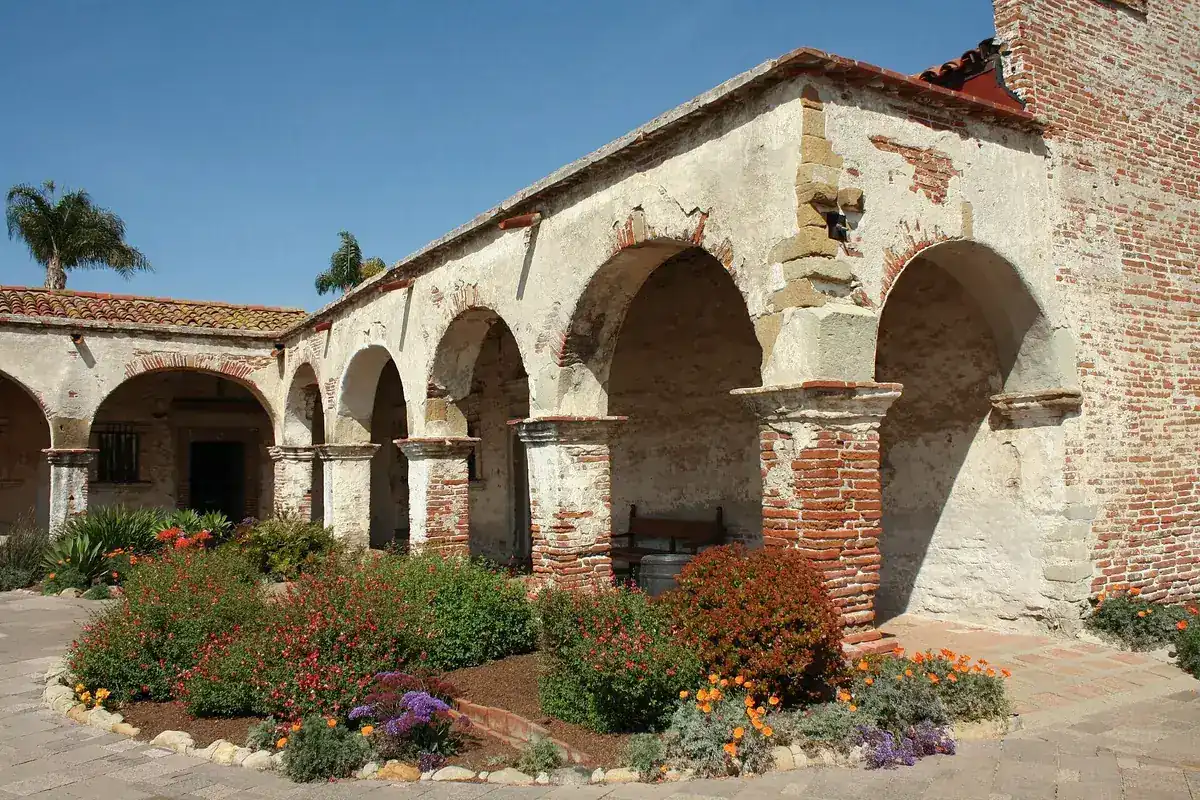
San Juan Capistrano has the deepest Spanish Colonial context in Orange County, and requests here skew accordingly: arched detailing, rustic alder and knotty pine, dark iron hardware, heavier door profiles, and cabinetry that reads as built rather than delivered. The Mission itself, its arched adobe and brick corridors, and the Los Rios Historic District are all part of why.
The honest thing to say is that style preference does not change construction rules. A rustic alder door with a hand-forged pull still needs its panel to float in its groove, because alder moves like any other hardwood. The federal dimensional change coefficient for red alder is 0.00256 tangentially, against 0.00194 for sugar pine and 0.00376 for white oak, which puts it towards the stable end but does not exempt it. The wood species guide has the full table and the arithmetic.
It is also worth separating this town from San Clemente, where the Spanish style has a different origin. San Clemente’s came from a 1925 developer’s deed clause requiring red tile roofs and white exteriors, which proved short-lived and was only ever about the outside of a building. San Juan Capistrano’s comes from actually having been founded by the Spanish in 1776. The Spanish Colonial cabinet guide sets out what each of those does and does not mean for a cabinet run.
Older housing, and why it suits drawn cabinetry
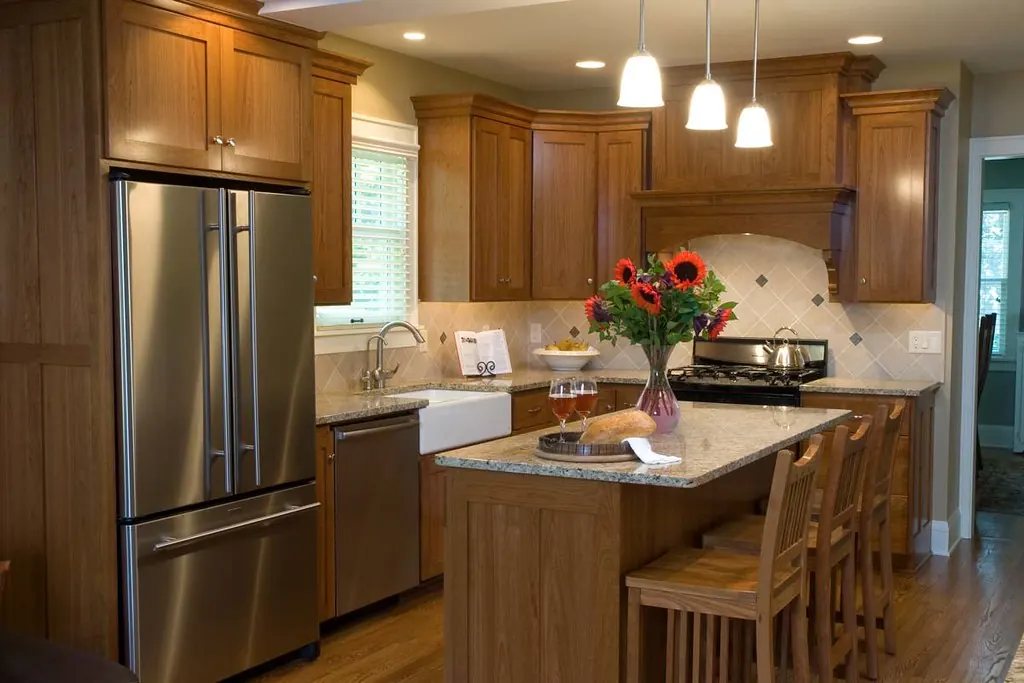
A town founded in 1776 and incorporated in 1961 has housing across a very wide age range, and the older end of it predates standard cabinet dimensions entirely. That is not a problem to be worked around, it is the condition drawn cabinetry exists for.
The techniques are the same ones used on the oldest housing in San Clemente: measure openings at top, middle and bottom rather than once; design scribe allowances into every edge that meets plaster rather than discovering them on install day; and set base cabinets from the highest point of the floor so the run is level rather than parallel to a floor that is not. All three are covered on the installation page, and they are what separates joinery that looks built into a house from joinery that looks placed in it.
| San Juan Capistrano | San Clemente | |
|---|---|---|
| Population | 35,196 | 64,293 |
| Housing units | 12,319 | 26,647 |
| Owner-occupied share of occupied units | 75.8% | 64.0% |
| Occupied share of all units | 96.2% | 91.9% |
| Median age | 44.1 | 43.9 |
| Median household income, 2023 estimate | $127,893 | $134,735 |
| Founded / incorporated | 1776 / 19 April 1961 | 1925 / 27 February 1928 |
Median household income figures are US Census Bureau estimates for 2023. The rest are 2020 decennial census figures.
San Juan Capistrano’s housing stock, in the City’s own Housing Element data
Just under 40 percent of San Juan Capistrano’s housing was built in a single decade, the 1970s, and the city has the largest households and the highest home ownership rate of the four cities we work in. Those three facts together explain why the cabinet work here looks different from the work a few miles down the coast. All of them come from the SCAG Pre-Certified Local Housing Data prepared for the City’s 6th Cycle Housing Element Update, updated April 2021, which is the dataset the City used to write its own Housing Element.
| Measure | San Juan Capistrano | Comparison |
|---|---|---|
| Total housing units | 12,558 | The smallest of the four cities here |
| Single-family detached units | 6,797 | 54.1 percent of all units |
| All single-family share | 73.5 percent | SCAG region 61.7 percent |
| Single-family attached | 19.4 percent | SCAG region 7.2 percent |
| Multifamily, 2 to 4 units | 6.8 percent | SCAG region 7.5 percent |
| Multifamily, 5 or more units | 8.6 percent | SCAG region 27.3 percent |
| Mobile homes | 11.1 percent | SCAG region 3.5 percent; by far the highest of the four cities |
| Occupied units | 11,870 | Total vacancy rate 5.5 percent |
| Average household size | 3.052 people | The largest of the four cities; Dana Point 2.332 |
| Owner-occupied share | 74.9 percent | SCAG region 52.5 percent |
| 2018 median home sales price, existing homes | $834,000 | Up 203 percent since 2000, the steepest rise of the four |
Figures from the SCAG Pre-Certified Local Housing Data, updated April 2021, prepared for the City of San Juan Capistrano's 6th Cycle Housing Element Update, drawing on California Department of Finance E-5 estimates and American Community Survey 2014-2018 five year estimates. Median sales price from SCAG Local Profiles and Core Logic / Data Quick.
The 11.1 percent mobile home share is the number that most changes what we quote here, and it is more than three times the regional figure. Cabinetry for a manufactured home is a genuinely different job: the openings are narrower, wall construction will not always take a standard fixing, floors are often not level across a run, and the maximum carcass that can be carried through the door is smaller. None of that rules the work out, and a drawn cabinet is frequently the only thing that will fit, but a stock package sized off a catalogue is close to guaranteed not to. If you are in a manufactured home, say so at the first conversation rather than at the survey.
The household size figure matters for a different reason. At 3.052 people per household against Dana Point’s 2.332, San Juan Capistrano households are on average three quarters of a person larger than their neighbours’ a few miles away, and that shows up as pantry demand, laundry demand and drawer demand rather than as display cabinetry. A four-person household generates a volume of dry goods, cleaning supplies and laundry that a two-person household does not, and the honest place to spend money in a kitchen here is usually drawer capacity and a pantry, not door profile.
The age distribution, and why 1970 to 1979 dominates it
| Year built | Share of units | SCAG region | Cabinet consequence |
|---|---|---|---|
| 1939 and earlier | 1.7 percent | 9.3 percent | Mission-era and early twentieth century stock in and around the Historic Town Center |
| 1940 to 1949 | 0.6 percent | 6.9 percent | Very little of it, and all of it inside the federal lead rule |
| 1950 to 1959 | 2.7 percent | 15.9 percent | Unusually thin compared with the region |
| 1960 to 1969 | 13.9 percent | 14.5 percent | Face frame boxes, original casework mostly replaced once already |
| 1970 to 1979 | 39.6 percent | 16.3 percent | Two and a half times the regional share. The defining decade here |
| 1980 to 1989 | 16.3 percent | 15.0 percent | Sound boxes with dated fronts: refacing and re-dooring territory |
| 1990 to 1999 | 14.2 percent | 9.5 percent | Full overlay, hinge boring usually reusable |
| 2000 to 2009 | 7.5 percent | 10.1 percent | Builder packages; paint-grade fronts are the weak point |
| 2010 to 2013 | 2.3 percent | 1.5 percent | Above the regional rate, unusually for South Orange County |
| 2014 and later | 1.2 percent | 1.0 percent | In line with the region |
Shares from the SCAG dataset above, citing American Community Survey 2014-2018 five year estimates.
Add the bands and 58.5 percent of the city’s housing predates 1980, with the single 1970s decade accounting for 39.6 percent of everything. That concentration is the most extreme of the four cities here and it has a practical consequence that is easy to miss: a very large share of San Juan Capistrano kitchens are the same age, built to the same conventions, with the same face frame construction and the same partial overlay doors. So the diagnosis is usually quick, the options are usually the same three, and the thing that varies is condition rather than type. It also means the 1978 lead line runs straight through the middle of the city’s largest housing cohort, which is the subject of the next section.
A town founded in 1776 is a pre-1978 town
San Juan Capistrano was founded on 1 November 1776 and incorporated on 19 April 1961, which means the overwhelming majority of its 12,319 housing units predate 1978. That brings the federal Renovation, Repair and Painting Rule into most cabinet jobs here as a matter of routine.
The rule applies to “houses, apartments and child-occupied facilities (such as schools and child care centers) built before 1978” and requires that “Anyone who is paid to perform work that disturbs paint in housing and child-occupied facilities built before 1978 must be certified. This includes all firms, even sole proprietorships.” California has no authorised state programme, so the EPA administers it here directly. Covered activities include remodeling, carpentry, plumbing, electrical work and painting preparation.
The exemption covers only “Minor repair and maintenance activities that disturb six square feet or less of paint per room inside, or 20 square feet or less on the exterior,” and the EPA states that window replacement and demolition of painted surfaces are “always covered regardless of square footage.” A kitchen strip-out is demolition of painted surfaces. The rule does not apply where components have been “declared lead-free by a certified inspector or risk assessor,” and the EPA lists EPA-recognised test kits, X-ray fluorescence instruments and paint chip sampling as the three testing routes, each with its own qualified user.
Permits here are San Juan Capistrano’s, not San Clemente’s
Worth stating plainly on a page written by a San Clemente business. San Clemente publishes an unusually detailed set of permit material, including its own amended exempt-work ordinance, a homeowner handout naming which appliances trigger which permit, and its adopted code editions. Those documents govern San Clemente addresses. San Juan Capistrano is a separate city with its own building department and its own process.
The consistent California position does transfer: cabinets are finish work, and the plumbing, electrical and mechanical work attached to a kitchen is separate and permitted on its own terms. So do the state-level protections. A home improvement contract over $500 must be in writing and signed before work starts under Business and Professions Code 7159, and changes to it must be written and signed too. The deposit is capped at $1,000 or ten percent of the contract, whichever is less, under 7159.5. A three business day right to cancel applies, five for a senior citizen, except where the contract was “Negotiated at the contractor’s place of business.” And the CSLB classification to ask for is C-6, Cabinet, Millwork and Finish Carpentry.
Specifying for a twenty year horizon
With 75.8 percent of occupied units owner-occupied, the highest share in this service area, San Juan Capistrano homeowners are typically specifying for a long horizon. The published service life figures are worth reading with that in mind, because they disagree in a way that maps onto exactly this distinction.
| Source | Kitchen cabinets | What the figure describes |
|---|---|---|
| NAHB and Bank of America Home Equity, 2007 | 50 years | Manufacturer survey: what a cabinet can do |
| InterNACHI Standard Estimated Life Expectancy Chart | 50 years | Home inspection reference |
| Fannie Mae Estimated Useful Life Tables, 2019 | 20 years wood, 15 particle board | Multifamily capital planning: what rental cabinets deliver |
| Georgia DCA Office of Affordable Housing, 2011 | 15 to 25 years | Affordable housing capital planning |
All reproduced in Appendix C of the Port of Seattle SEA-SIPP Technical Report. The NAHB study states its figures are "based on first-owner use" and that life expectancy "is greatly affected by the quality of maintenance", both of which describe an owner-occupier rather than a tenancy.
An owner-occupier planning to be there in twenty years should be specifying towards the manufacturer end of that spread, and the decisions that get you there are unglamorous: a plywood sink base, hardware that survives, joined rather than stapled drawer boxes, and a door profile and species that will still read well after a decade rather than one that is currently fashionable.
One certification is worth asking about regardless of horizon. The Kitchen Cabinet Manufacturers Association’s ANSI/KCMA A161.1 scheme covers “rigorous tests of their structural strength, drawer and door integrity, and finish durability,” with certified cabinets having “passed 14 rigorous tests, including a 600-pound load test.” The association reports that “Between 40% and 50% of cabinets fail their first certification attempt,” and that certification is “available at every price point.”
What we do in San Juan Capistrano
All seventeen services on the services hub are available here. Three come up more often in this town than elsewhere in the service area.
Custom cabinetry in the older housing, where catalogue sizes genuinely do not fit and where the Spanish Colonial preference calls for door profiles that are not standard catalogue items. Covered on the custom cabinets page.
Refinishing rather than painting, because a town that favours visible timber tends to have timber worth keeping. Refinishing strips back to the original wood and builds a new clear or stained finish, which is the only one of the three renewal services that keeps the grain. See cabinet refinishing.
Built-ins, particularly alcove cupboards and window seats in older rooms, where scribing quality decides how the finished work reads. See built-ins and media walls.
- In an older house, expect scribe allowances everywhere and budget for them rather than being surprised
- For a Spanish Colonial look, insist that stile and rail doors float their panels regardless of style
- Specify plywood at the sink base, which matters more on a twenty year horizon than on a five year one
- Confirm permit requirements with the City of San Juan Capistrano, which has its own building department
- If matching existing timber work, plan for the aged finish rather than assuming a match
- Ask about refinishing before assuming a tired timber kitchen needs replacing
What a timber-led market means for the finish
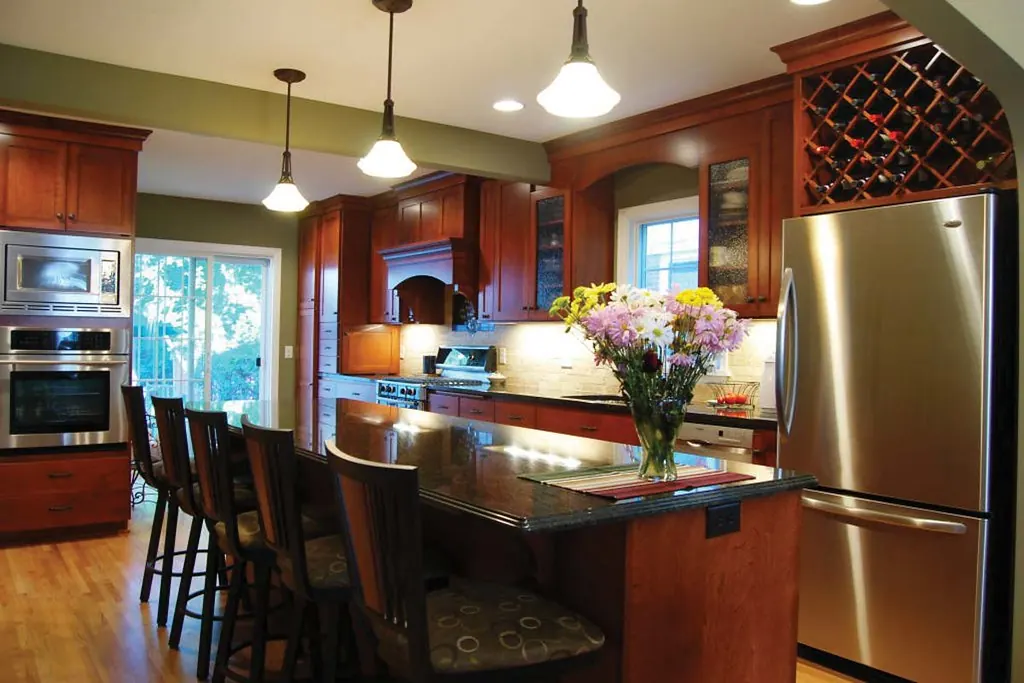
A town that favours visible grain puts more weight on the finish than one that favours painted cabinetry, and the finish is governed by published rules rather than by preference. San Juan Capistrano sits inside the South Coast Air Quality Management District, which lists the incorporated cities within its four-county jurisdiction.
Rule 1136, Wood Products Coatings, amended 5 June 2026, governs shop application, setting 275 grams of VOC per litre for clear and pigmented primers, sealers, undercoats and topcoats, and 350 for high-solids stains. Rule 1113, Architectural Coatings, amended 5 February 2016, governs on-site application, setting 275 grams per litre for wood coatings, varnish, sanding sealers and lacquer, 250 for interior stains and 100 for wood conditioners.
The practical consequence for a stained kitchen is that the products available here are compliant waterborne systems rather than old high-solvent lacquers, and they behave differently in flow, open time and cure. That is a skill question rather than a quality one: modern waterborne conversion varnishes are excellent, and a finisher who works to them every week gets better results than one who does not. The full tables are in the finishes and VOC rules guide.
On the panels underneath, California’s Green Building Standards Code requires composite wood products to meet the CARB Air Toxics Control Measure limits, with maximum emissions of 0.05 parts per million for hardwood plywood, 0.09 for particleboard and 0.11 for medium density fiberboard, tested to ASTM E1333. Solid wood is not a composite wood product and is not labelled under that rule, which is worth knowing in a market where solid timber doors are the norm.
The rest of the service area
South and along the coast: Dana Point and Capistrano Beach, then San Clemente itself, including Talega. North and inland, Laguna Niguel. The whole coverage, and what changes between one part of it and another, is on the service area page.