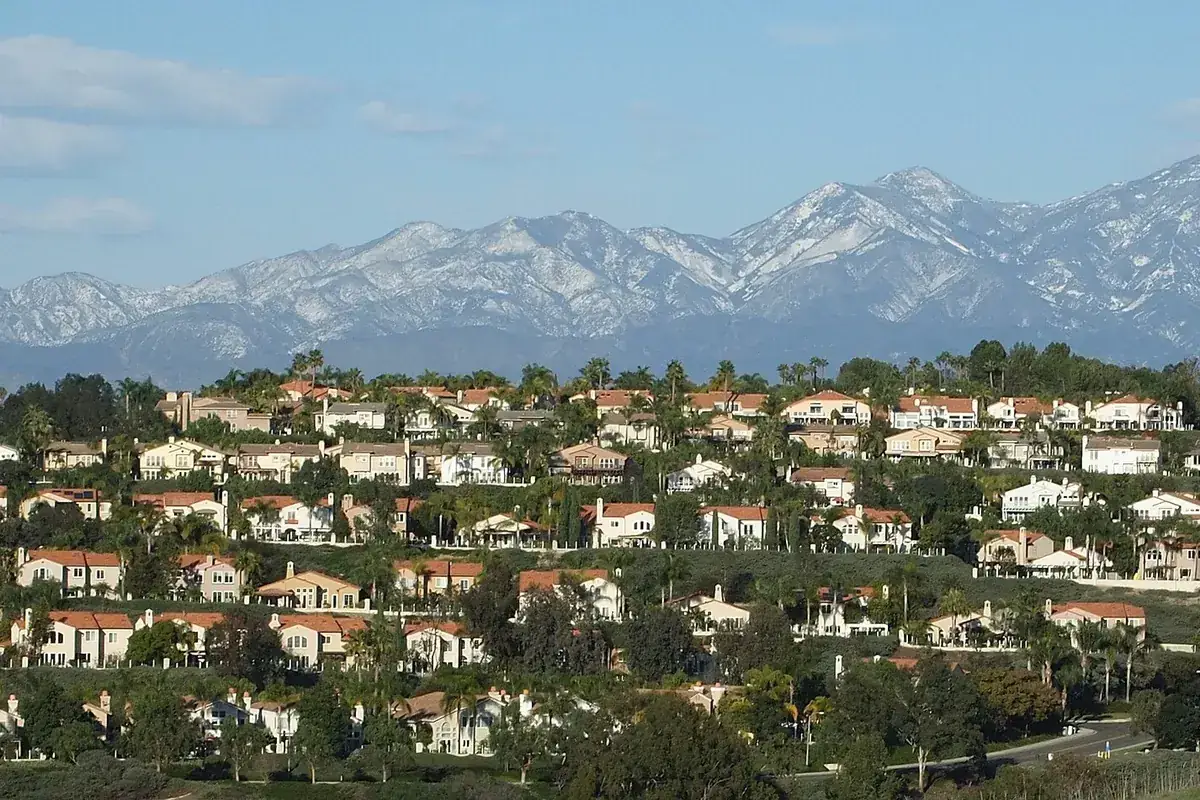
Laguna Niguel, briefly and accurately
Laguna Niguel had a population of 64,355 at the 2020 census, which makes it fractionally larger than San Clemente, and covers 14.8 square miles of which 14.7 is land. It incorporated on 1 December 1989 as Orange County’s 29th city, and it did so without its coastal strip: Monarch Beach residents voted to join Dana Point instead, and a lawsuit by Laguna Niguel over that was turned down by a judge.
Its origin matters for cabinetry. The Laguna Niguel Corporation purchased the Daguerre land to develop what is described as one of California’s first master planned communities, and Cabot Road and Forbes Road are named after the company. That means the housing stock is overwhelmingly planned tract development rather than the century-long patchwork of San Clemente, and it produces a very different cabinet market.
The named neighbourhoods are numerous and worth listing because they are how people describe where they live here: Bear Brand Ranch, San Marin, El Niguel Heights and Golf Course, Ocean Ranch, Laguna Crest, Laguna Sur, Coronado Pointe, South Peak, Crest de Ville, Niguel Coast, Palmilla, Beacon Hill, Monarch Point and the Highlands, plus Rancho Niguel, Marina Hills, Concord Hill, Niguel West, Niguel Summit, Kite Hill, Rolling Hills and the San Joaquin Hills.
Why this is refacing territory
In a planned tract development, the three things that usually make a kitchen wrong are all absent. The layout was designed rather than accumulated, so the traffic pattern and the appliance positions generally work. The cabinet sizes were drawn to the house, so filler strips are modest. And the original package was ordered as a job lot, which means it was at least consistent.
What is left to dislike is the door profile, the colour, the lack of drawers in the base run, and the gap between the uppers and the ceiling. Every one of those is addressable without new carcasses. Refacing replaces the doors, fronts and visible skins while keeping the boxes, and published San Clemente-area figures model laminate refacing of a twelve cabinet kitchen at $1,577 to $2,482, an average of $131 to $207 per cabinet, against real wood veneer at roughly $2,000 to $6,000.
Compare that with replacement at published California custom rates of $500 to $1,200 per linear foot, and the arithmetic on a sound tract kitchen is not close. Being told that is a better outcome than being sold a kitchen, and it is the most common honest recommendation we give in this city.
Drawer conversions, the other high-value job here
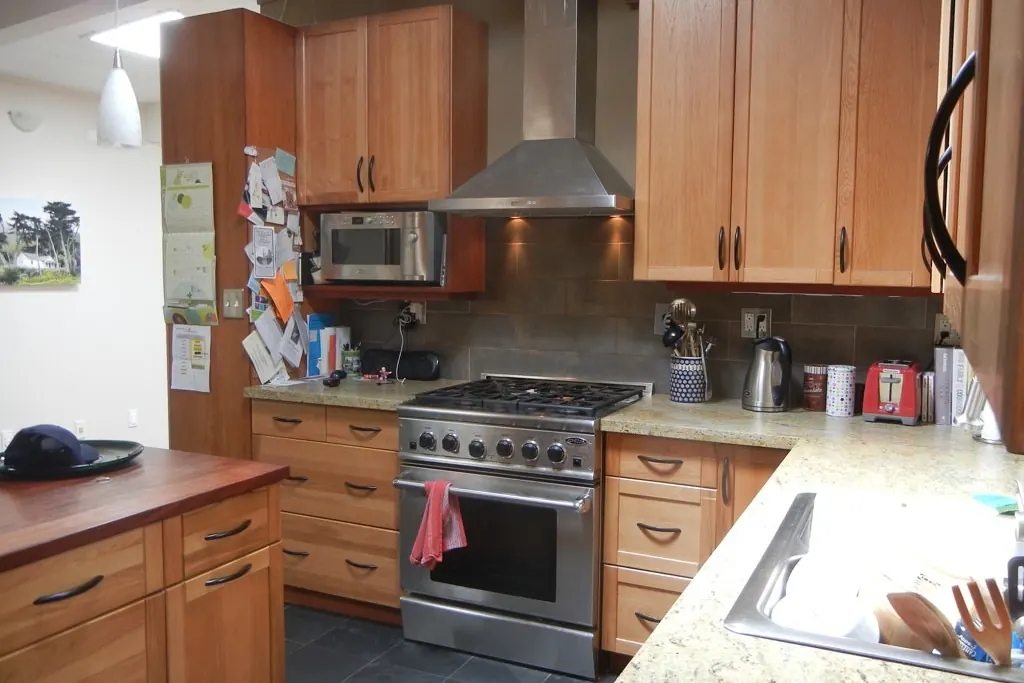
The second most common request in Laguna Niguel is drawers where the builder fitted doors, and it is the single change most likely to make a homeowner say the kitchen feels different. A door with a fixed shelf behind it means kneeling and reaching past the front row; a bank of drawers brings the back row to the front.
It is a genuine cost line rather than a free upgrade, because a drawer is five joined parts plus a pair of slides while a door is one part and two hinges, and a full-extension slide rated to carry a loaded pot drawer is a real component. It is also a carcass change in most cases, which puts it on the edge between refacing and new cabinetry, and it is worth pricing explicitly rather than assuming. The hardware page covers slide specification.
Matching a builder package
The third recurring job here is an addition matched to what is already there: a butler’s pantry, a bar run, a laundry room refit, a home office, or built-ins elsewhere in the house, all in the same species and profile as the original kitchen.
Matching means matching four things and only three of them reproduce reliably.
| Element | Reproducible? | Note |
|---|---|---|
| Species | Yes | Provided the original is identified correctly, which needs a look not a guess |
| Door profile | Yes | Machined to match, even where the original supplier no longer exists |
| Overlay | Yes | Measured from the existing doors and openings |
| Finish colour and sheen | Partially | An aged clear coat has ambered; a new one reads lighter |
The practical responses to the fourth row are a deliberate contrast, replacing a whole visually connected run, or toning new work to the old. The last is skilled and worth asking about by name.
Where Laguna Niguel sits in the numbers
| Laguna Niguel | San Clemente | |
|---|---|---|
| Population | 64,355 | 64,293 |
| Housing units | 27,281 | 26,647 |
| Owner-occupied share of occupied units | 67.1% | 64.0% |
| Median age | 47.0 | 43.9 |
| Median household income, 2023 estimate | $140,605 | $134,735 |
| Incorporated | 1 December 1989 | 27 February 1928 |
| Land area | 14.7 sq mi | 18.36 sq mi |
Median household income figures are US Census Bureau estimates for 2023. The rest are 2020 decennial census figures. Laguna Niguel and San Clemente are within 62 people of each other in population.
Housing age here cuts both ways
Laguna Niguel incorporated on 1 December 1989, but the Laguna Niguel Corporation began developing the land long before that, and a model home photographed in the Terrace tract dates from 1961. So the housing spans roughly six decades, and the 1978 line runs straight through the middle of it.
That line matters because of the federal Renovation, Repair and Painting Rule, which the EPA administers directly in California. It applies to housing “built before 1978” and requires that “Anyone who is paid to perform work that disturbs paint in housing and child-occupied facilities built before 1978 must be certified. This includes all firms, even sole proprietorships.” It exempts “Minor repair and maintenance activities that disturb six square feet or less of paint per room inside,” with demolition of painted surfaces covered regardless of area, and it does not apply at all to “Housing built in 1978 or later.”
The practical consequence in a city with this build spread is that the answer genuinely depends on the address. A 1960s or 1970s tract house is inside the rule; a 1990s hillside house is not. Establishing which before collecting quotes saves a conversation, and a contractor who asks the question unprompted is a contractor who knows the rule exists.
The Housing Element data, which proves the refacing case
Almost 69 percent of Laguna Niguel’s housing was built between 1980 and 1999, which is why this page opens with refacing rather than with new cabinetry. That figure is published in the SCAG Pre-Certified Local Housing Data prepared for the City’s 6th Cycle Housing Element Update, updated April 2021, the dataset the City used to write its own Housing Element. It is the single most useful number about cabinets in this city, because a box built in the 1980s or 1990s is old enough to look dated and young enough to still be structurally sound, and that is exactly the window in which refacing beats replacement on value.
| Measure | Laguna Niguel | Comparison |
|---|---|---|
| Total housing units | 26,236 | San Clemente 26,573; the two cities are near identical in size |
| Single-family detached units | 14,527 | 55.4 percent of all units |
| All single-family share | 74.8 percent | SCAG region 61.7 percent; the highest of the four cities here |
| Single-family attached | 19.5 percent | SCAG region 7.2 percent |
| Multifamily, 2 to 4 units | 5.4 percent | SCAG region 7.5 percent |
| Multifamily, 5 or more units | 19.6 percent | SCAG region 27.3 percent |
| Mobile homes | 0.2 percent | SCAG region 3.5 percent; effectively none |
| Occupied units | 24,869 | Total vacancy rate 5.2 percent, the lowest of the four |
| Average household size | 2.609 people | San Clemente 2.642 |
| Owner-occupied share, ACS 2014-2018 | 70.0 percent | SCAG region 52.5 percent |
| 2018 median home sales price, existing homes | $800,000 | Up 145 percent since 2000 |
Figures from the SCAG Pre-Certified Local Housing Data, updated April 2021, prepared for the City of Laguna Niguel's 6th Cycle Housing Element Update, drawing on California Department of Finance E-5 estimates and American Community Survey 2014-2018 five year estimates. The owner-occupied share differs slightly from the 2020 census figure in the table above because the two use different releases; both are given with their vintage rather than blended.
The age distribution, which is unlike anywhere else on this coast
| Year built | Laguna Niguel | SCAG region | Cabinet consequence |
|---|---|---|---|
| 1939 and earlier | 0.5 percent | 9.3 percent | Almost none. This city has no pre-war housing to speak of |
| 1940 to 1949 | 0.2 percent | 6.9 percent | Effectively none |
| 1950 to 1959 | 1.2 percent | 15.9 percent | A thirteenth of the regional share |
| 1960 to 1969 | 5.5 percent | 14.5 percent | The earliest meaningful band, from the original Laguna Niguel plan |
| 1970 to 1979 | 17.7 percent | 16.3 percent | In line with the region. Face frame construction, straddles the 1978 lead line |
| 1980 to 1989 | 44.5 percent | 15.0 percent | Nearly three times the regional share and the largest single band anywhere in this service area |
| 1990 to 1999 | 24.2 percent | 9.5 percent | Two and a half times the regional share. Full overlay, sound boxes |
| 2000 to 2009 | 4.7 percent | 10.1 percent | Less than half the regional rate; the city was largely built out |
| 2010 to 2013 | 0.7 percent | 1.5 percent | Effectively nothing |
| 2014 and later | 0.8 percent | 1.0 percent | Effectively nothing |
Shares from the SCAG dataset above, citing American Community Survey 2014-2018 five year estimates.
Read the two largest bands together and 68.7 percent of Laguna Niguel’s housing dates from 1980 to 1999, against 24.5 percent regionally. There is no other city in this service area with a profile remotely like that. Dana Point peaks in the 1970s, San Juan Capistrano peaks harder in the 1970s still, and San Clemente is split between the 1970s and the 2000s. Laguna Niguel is a tract city built in two decades, and that produces a market where thousands of kitchens share a construction era, a box depth, a hinge type and a door style.
Three consequences follow, and they are the reason this page is structured the way it is. First, only 7.4 percent of the city’s housing predates 1970, so the federal lead rule is a far smaller factor here than in Capistrano Beach or San Juan Capistrano, and the 1970 to 1979 band at 17.7 percent is the part where the question genuinely arises. Second, a city built in the 1980s and 1990s is overwhelmingly a city of full and partial overlay doors on face frame boxes with cup hinges, which is the construction that refaces and re-doors most cleanly. Third, at 5.2 percent vacancy and 70 percent owner occupancy this is the most settled of the four cities, which changes the economics: an owner living in the house for another fifteen years is buying a finish they will look at, not a finish a tenant will look at.
The 19.5 percent single-family attached share is the one number that argues against a purely refacing story. That is nearly three times the regional figure, and attached homes in this city mean narrower kitchens, shared walls and a maximum carcass size set by a stair or a corridor. Where a plan genuinely needs rearranging rather than resurfacing, an attached home is usually where that turns up, and it is the case in which new drawn cabinetry beats refacing on the merits rather than on aesthetics.
Permits here are Laguna Niguel’s
San Clemente publishes an unusually detailed permit framework, including its own amended exempt-work ordinance, a homeowner handout naming which appliances trigger which permit, and its adopted code editions. All of that governs San Clemente addresses. Laguna Niguel is a separate city with its own building department and its own process, and its requirements should be confirmed with that city.
The California-wide position transfers: cabinets are finish work and the plumbing, electrical and mechanical work attached to them is separate. So do the statutory protections, which are the ones worth knowing. A written, signed contract before work starts on anything over $500 under Business and Professions Code 7159, with changes also written and signed. A deposit capped at $1,000 or ten percent of the contract, whichever is less, under 7159.5. A three business day right to cancel, five for a senior citizen, except where the contract was negotiated at the contractor’s place of business. And a CSLB licence, classification C-6 for cabinet, millwork and finish carpentry, checkable on the Board’s public lookup in about ninety seconds.
Certification, which matters more in a tract market
In a city built largely from production housing, a great many original cabinet packages came from the same handful of manufacturers, and the question of whether those manufacturers tested their product is answerable.
The Kitchen Cabinet Manufacturers Association runs the ANSI/KCMA A161.1 certification, covering “rigorous tests of their structural strength, drawer and door integrity, and finish durability.” Certified cabinets have “passed 14 rigorous tests, including a 600-pound load test, to simulate a lifetime of use,” and the association reports that “Between 40% and 50% of cabinets fail their first certification attempt.” Crucially for a tract market, certified cabinets are “available at every price point, from builder-grade units to high-end, custom designs.”
The point for a Laguna Niguel homeowner deciding between refacing and replacing is this: a certified builder-grade carcass that has spent twenty-five years dry and square is a better base for new doors than an uncertified premium one that has been under a weeping sink. The test in the callout above is what tells you which you have. Certification tells you what it was capable of when new.
| Source | Kitchen cabinets | Note |
|---|---|---|
| NAHB and Bank of America Home Equity, 2007 | 50 years | Manufacturer survey, first-owner use |
| InterNACHI chart | 50 years | Home inspection reference |
| Fannie Mae Estimated Useful Life Tables, 2019 | 20 years wood, 15 particle board | Multifamily capital planning |
| Georgia DCA, 2011 | 15 to 25 years | Affordable housing capital planning |
Reproduced in Appendix C of the Port of Seattle SEA-SIPP Technical Report. A 1990s tract kitchen is roughly thirty years old, which is past every lender figure and inside both manufacturer figures. Which is why the physical test matters more than the arithmetic.
What we do in Laguna Niguel
All seventeen services on the services hub are available here, with the emphasis different from the coastal towns.
- Check the sink base before spending anything, because it decides between refacing and replacing
- Price a drawer conversion in the base run separately, because it is the highest-value change in most tract kitchens
- If matching an existing package, identify the species properly rather than guessing from a photograph
- Plan for the aged finish rather than assuming a new door will match an old one
- In the garage, specify corrosion-resistant hardware even though the house itself is inland
- Confirm permit requirements with the City of Laguna Niguel, which has its own building department
If the boxes have failed or the layout genuinely needs changing, the custom cabinets page covers new cabinetry, and the three-way comparison guide sets out all three options with the published numbers side by side.
Panels and finishes, which do not vary by city
Two sets of rules apply identically in Laguna Niguel and everywhere else in this service area, and both are worth a line because they come up in quotes.
On panels, California’s Green Building Standards Code requires that “Hardwood plywood, particleboard and medium density fiberboard composite wood products used on the interior or exterior of the building shall meet the requirements for formaldehyde as specified in ARB’s Air Toxics Control Measure (ATCM) for Composite Wood (17 CCR 93120 et seq.),” with maximum emissions of 0.05 parts per million for hardwood plywood, 0.09 for particleboard and 0.11 for medium density fiberboard, tested to ASTM E1333. Federal TSCA Title VI sets matching limits and requires a compliance label.
On finishes, Laguna Niguel sits inside the South Coast Air Quality Management District along with the rest of the area, so Rule 1136 governs shop application and Rule 1113 governs on-site application, both setting 275 grams of VOC per litre on the coatings that matter most for cabinetry. That is why professional cabinet finishing here is overwhelmingly waterborne, and it applies whether the shop is in Laguna Niguel or anywhere else in the district. The detail is in the finishes and VOC rules guide.
The rest of the service area
South and coastward: Dana Point and Capistrano Beach. Inland and south, San Juan Capistrano. Then San Clemente itself, including Talega, whose newer housing raises exactly the same matching questions this page describes. The whole coverage is on the service area page.