The one paragraph version
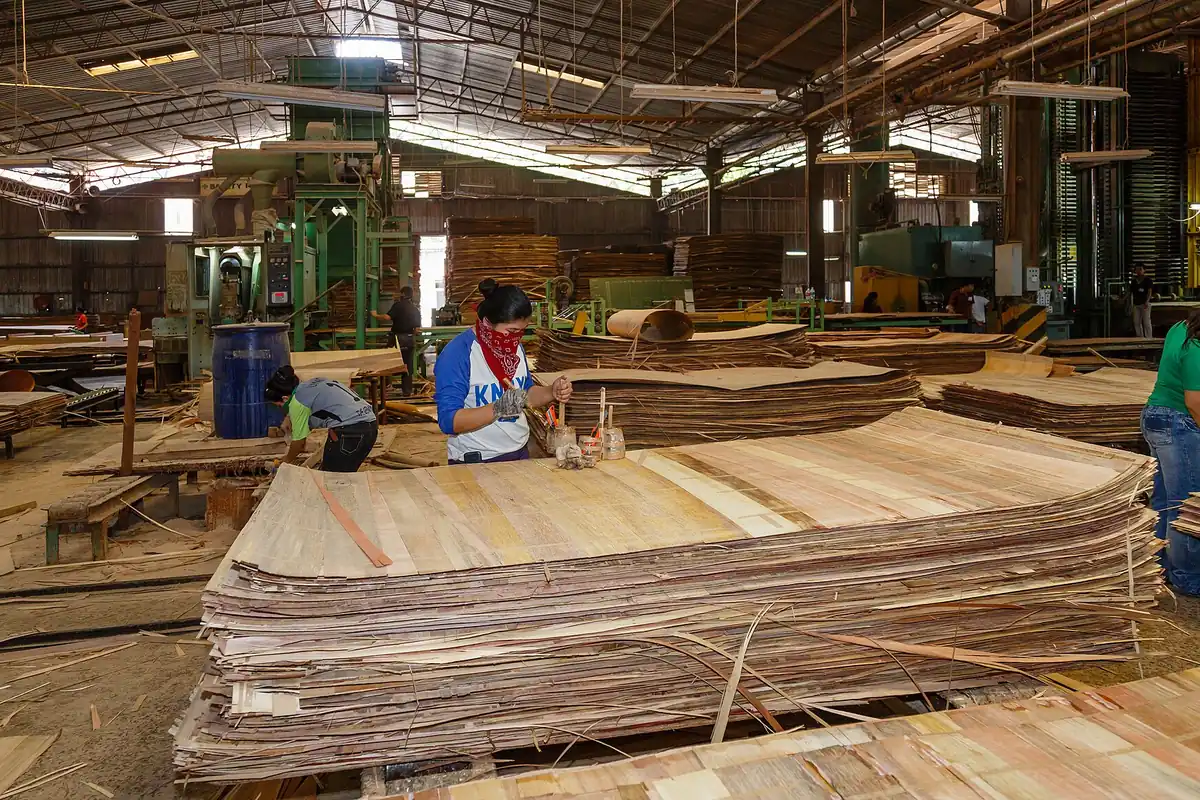
Specify plywood for the sink base and the dishwasher run, and decide the rest on budget. That single sentence covers ninety percent of the value in this decision, because the sink base is the cabinet that sits under a plumbing connection that will eventually weep, and it is the cabinet whose failure ends the useful life of a kitchen that is otherwise fine.
Everything else on this page is the evidence for that sentence, plus the material properties that decide the other cabinets, plus the rules that govern what can legally be sold for the purpose in California.
The three materials, on the properties that matter
| Plywood | MDF | Particleboard | |
|---|---|---|---|
| Screw holding | Best of the three, cross-laminated plies grip a thread | Moderate, better on the face than the edge | Weakest, strips under cyclic load |
| Response to water | Swells then largely recovers | Swells and does not recover | Swells and does not recover |
| Flatness | Good, occasional slight bow | Excellent, no grain telegraph | Good |
| Weight | Lightest | Heaviest | Middle |
| Takes a painted finish | Grain can telegraph | Best of the three | Needs a good surface |
| Where it belongs | Sink base, dishwasher run, anything near plumbing | Painted doors and fronts, dry cabinets | Dry uppers, short horizons, rentals |
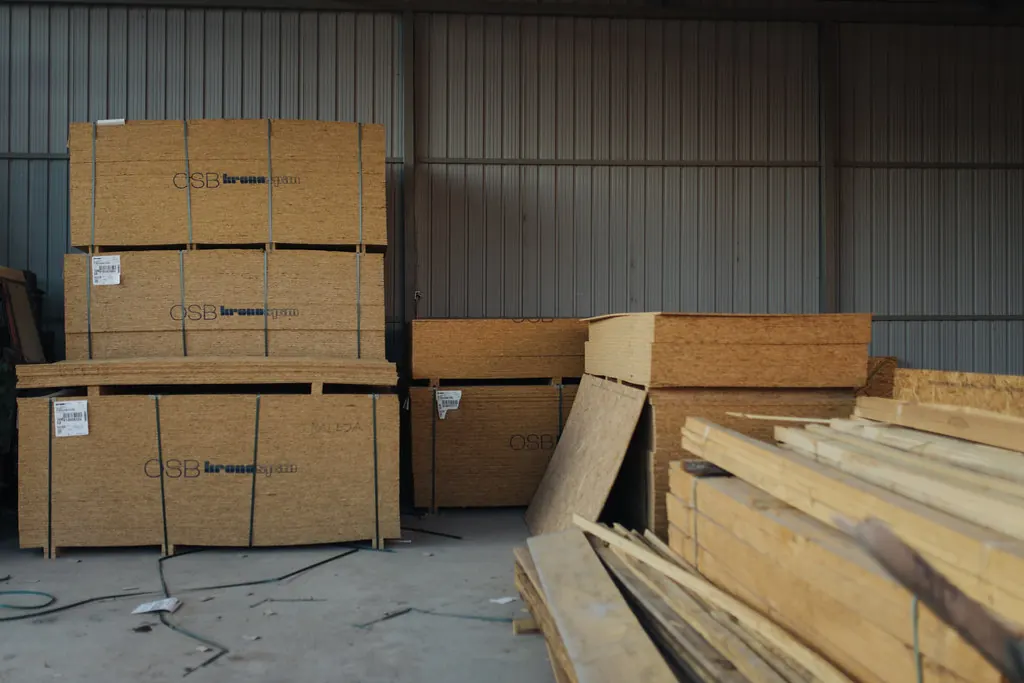
All three are composite wood products under California and federal formaldehyde rules, and all three are legitimate in the right position. The mistake is using one material everywhere because it simplified the quote.
Why screw holding matters more than it sounds
A cabinet is held together, and held to the wall, by threads in a panel edge or face. Hinge plates, drawer slides, shelf standards and the fixings into the wall all rely on it. A stripped hinge screw in a particleboard carcass is the single most common cabinet repair, and the correct fix is to plug the hole with solid timber and redrill rather than to fill it and hope, which is covered on the repair page.
Why water behaves differently in each
Plywood is thin layers of timber glued cross-grain. Wetted, it swells and, as it dries, largely returns, because the wood itself is dimensionally recoverable. MDF and particleboard are wood fibre or chips bound in resin and compressed. Wetted, the fibres swell and the compression is permanently lost, so the panel stays thicker, softer and weaker for ever. That is why a swollen particleboard sink base deck never comes back and why pressing it with a thumb is such a reliable test.
Four published tables, and what their disagreement tells you
Cabinet service life is published by four different bodies for four different purposes, and they do not agree. That is not a flaw in the data. The spread is the most informative thing about it.
| Source | Kitchen cabinets | Notes |
|---|---|---|
| NAHB and Bank of America Home Equity, February 2007 | 50 years | From a telephone survey of manufacturers, trade associations and researchers |
| InterNACHI Standard Estimated Life Expectancy Chart | 50 years | Also gives bathroom cabinets 50+, garage and laundry 70+, closet shelves 100+ |
| Fannie Mae Estimated Useful Life Tables, Form 4099.F, August 2019 | 20 years wood, 15 particle board | Multifamily property; the only source that splits the two materials |
| Georgia DCA Office of Affordable Housing, 2011 Architectural Manual | 15 to 25 years | Expected useful life for capital planning, action = replace |
All four are reproduced in Appendix C of the Port of Seattle SEA-SIPP Technical Report on life expectancy of building materials, which is where they were read for this guide.
The manufacturer-sourced figures describe what a cabinet can do. The lender and capital-planning figures describe what cabinets in real buildings do, in portfolios somebody is budgeting to maintain. Neither is wrong; they answer different questions. The NAHB study is candid about this itself, noting that “Many of the people interviewed emphasized that the life expectancy of housing components is greatly affected by the quality of maintenance,” and that “changing consumer preferences can result in products being replaced long before, or after, the end of their practical life expectancy.” Its figures are also explicitly “based on first-owner use.”
All four tables, reproduced in one document→
Formaldehyde: what California requires of the panels
Every composite wood panel used inside a California building has to meet a published emissions limit, and the rule is specific about the product types and the numbers.
The state’s Green Building Standards Code requires that “Hardwood plywood, particleboard and medium density fiberboard composite wood products used on the interior or exterior of the building shall meet the requirements for formaldehyde as specified in ARB’s Air Toxics Control Measure (ATCM) for Composite Wood (17 CCR 93120 et seq.)”
| Product | Maximum emissions, ppm |
|---|---|
| Hardwood plywood, veneer core | 0.05 |
| Hardwood plywood, composite core | 0.05 |
| Particleboard | 0.09 |
| Medium density fiberboard | 0.11 |
| Thin medium density fiberboard | 0.13 |
Values are derived from the California Air Resources Board measure and are tested in accordance with ASTM E1333.
Two details are worth noticing. First, hardwood plywood is held to a limit roughly half that of particleboard and less than half that of MDF, which reflects how much resin each contains. Second, “thin” MDF, defined by a maximum thickness, carries a higher limit than standard MDF, because thin panels are used in places like drawer bottoms and cabinet backs where the surface-area-to-volume ratio differs.
The documentation an enforcing agency accepts includes product certifications and specifications, chain of custody certifications, product “labeled and invoiced as meeting the Composite Wood Products regulation”, and exterior grade products marked to PS-1, PS-2, AS/NZS 2269 or European 636 3S.
Federally, TSCA Title VI sets matching limits, and since 22 March 2019 covered products must be labelled as TSCA Title VI compliant and certified by an EPA-recognised third party certifier. Solid wood is not a composite wood product and is not labelled under either rule, which is a genuine distinction rather than an oversight.
The CALGreen composite wood products section and table→ and the federal TSCA Title VI standard→
Testing: the KCMA certification and what it involves
Emissions limits are a legal floor. Structural performance is voluntary, and the main scheme is the Kitchen Cabinet Manufacturers Association’s ANSI/KCMA A161.1 certification, which covers “rigorous tests of their structural strength, drawer and door integrity, and finish durability.”
Certified cabinets have “passed 14 rigorous tests, including a 600-pound load test, to simulate a lifetime of use.” The most revealing figure the association publishes is how hard that is: “Between 40% and 50% of cabinets fail their first certification attempt.” For anybody who assumed a cabinet coming out of a factory has been tested, that is a useful corrective.
KCMA also notes certified cabinets are “available at every price point, from builder-grade units to high-end, custom designs”, which means certification is not a proxy for price. Two related programmes are worth knowing: the Environmental Stewardship Program, which certifies manufacturers on sustainability practices rather than the cabinet itself, and the Severe Use Certification, “originally developed by the U.S. Department of Housing and Urban Development (HUD)”, for cabinets that must “withstand the exceptionally high levels of wear that apartment building kitchens often encounter”. The latter is the right thing to ask about when specifying a rental.
KCMA certification programmes→
Where each material belongs in a real kitchen
| Position | Recommended | Why |
|---|---|---|
| Sink base | Plywood, no exception | Sits under a connection that will eventually weep |
| Dishwasher run | Plywood | Second most likely position for a slow leak |
| Base cabinets generally | Plywood if budget allows, else particleboard | Weight, screw holding, occasional spills |
| Wall cabinets | Particleboard acceptable | Dry, lighter loads, screw holding matters at the fixings |
| Tall units and pantries | Plywood if carrying tins | Heavy static loads on shelves and on the fixings |
| Painted doors and fronts | MDF | Flattest surface, no grain telegraph, dimensionally stable |
| Stained doors and fronts | Solid hardwood with a floating panel | Grain is the point; construction must let it move |
| Drawer boxes | Solid timber or plywood, joined not stapled | Racking under load is what fails a drawer |
| Cabinet backs | Thin MDF or plywood, rebated in | A stapled-on back is what lets a carcass rack |
A quote that gives one material for the whole kitchen has either over-specified the dry cabinets or under-specified the wet ones. Ask for it by position.
The edges, which nobody asks about
Every cut edge on an MDF or particleboard panel is exposed fibre, and exposed fibre wicks moisture. Edge banding is what closes it, and the quality of banding is one of the clearest differences between careful and careless work. It matters most in three places: the front edge of a sink base deck, the bottom edge of any cabinet in a laundry or a garage, and the cut-out at the back of a vanity where the plumbing passes through, which is often left raw because nobody sees it.
The same logic applies to a garage cabinet sitting directly on a slab: the panel bottom is an edge, the slab moves moisture upward, and the fix is a plinth or feet rather than a better panel.
What to ask, in one sentence each
- What is the sink base made of, specifically, and is that different from the rest of the kitchen?
- Is every cut edge banded, including the plumbing cut-out at the back?
- Are the cabinet backs rebated into the sides or stapled on?
- Are the drawer boxes joined or stapled, and what are they made of?
- Can I see the TSCA Title VI or CARB compliance stamp on a sheet of the panel?
- Are the cabinets ANSI/KCMA A161.1 certified, and if not, why not?
- If this is for a rental, is Severe Use certification available?
The tier question, which is separate from the material question and frequently confused with it, is in the custom versus semi-custom versus stock guide. The species question, which applies to doors and drawer fronts rather than carcasses, is in the wood species guide. And the work itself is on the custom cabinets page.