Talega is a Specific Plan area, and that is a useful fact
Talega is a neighbourhood of San Clemente rather than a separate city, and the City itself names it as one of seven areas it regulates through Specific Plans. The City’s own wording on its design guidelines page is that “There are several areas of the City that are regulated by Specific Plans, including Forster Ranch, Marblehead Coastal, Marblehead Inland, Pier Bowl, Rancho San Clemente, Talega, and West Pico Corridor.”
That list is worth having because it is the City’s own map of how San Clemente was built, and it lines up almost exactly with the eras of cabinetry found in each area. Pier Bowl is the old downtown core. Rancho San Clemente and Forster Ranch are the 1980s and 1990s hillside development. Talega and Marblehead Coastal are the newest. Which of those a house sits in predicts the cabinet job more reliably than anything else about it.
This page does not state a population figure, a build-year range or a household statistic for Talega, because no source for one was verified and inventing a number to look local is the thing this site does not do. What is verifiable is the City’s own Specific Plan framework, and that is enough to be useful.
Why the job here is addition rather than replacement
In the newest parts of San Clemente the builder cabinet package was competent rather than cheap, the ceilings are tall, the layout was drawn by somebody who had thought about it, and there is usually a walk-in pantry already. Nothing has failed. The sink base is not soft. The face frames are square. The layout works.
So the honest recommendation is almost never a new kitchen. It is one or more of four additions, each of which leaves the working kitchen alone.
Crown that reaches the ceiling
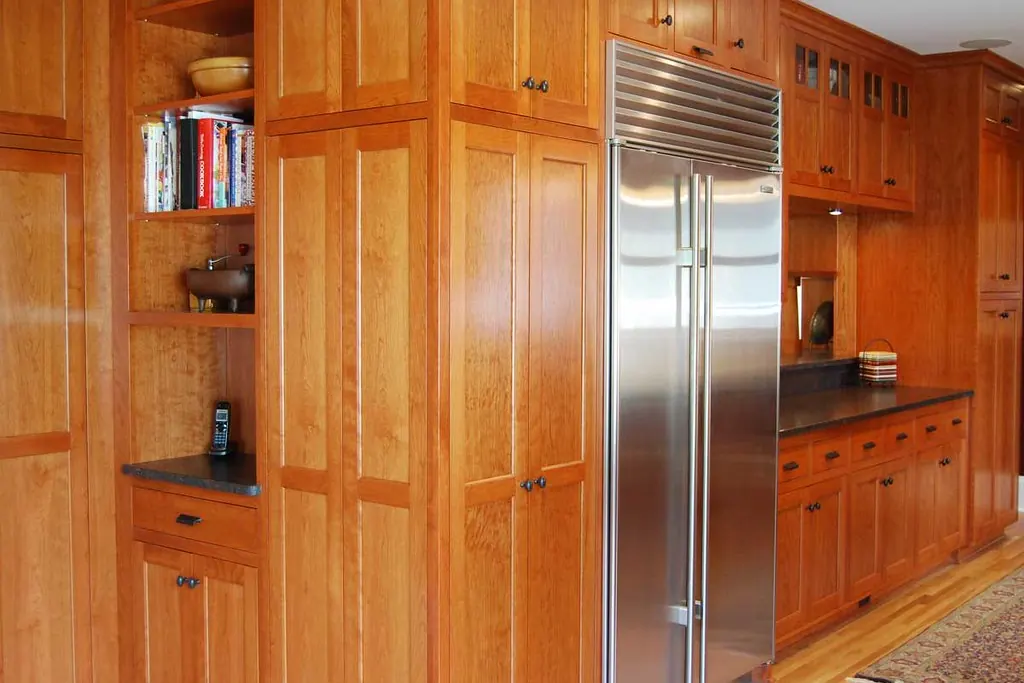
Tall ceilings and a standard-height wall cabinet leave a gap, and in a newer house that gap is often finished with a token moulding rather than closed. Extending the run, or adding a stacked upper tier and taking the crown to the ceiling, recovers real storage and finishes the elevation properly. It is also the single most common request in Talega-era houses.
A butler’s pantry or bar run
The second most common. A run of cabinetry between the kitchen and the dining room, or in an adjacent alcove, matched to the existing doors, with glass storage, bottle storage and a work surface. If it carries a sink or an under-counter refrigerator, that is plumbing or electrical work with its own permit alongside exempt cabinetry. The wine and bar page covers what such a run should actually contain, including the drawer for the things that are not bottles or glasses.
Drawer conversions inside existing carcasses
Builder packages frequently use doors with fixed shelves in the base run because doors are cheaper than drawers. Converting those to drawers is the change most likely to make a kitchen feel different, and in many cases it can be done inside the existing carcass by fitting drawer boxes and slides behind a new front. Where the carcass cannot take it, it becomes a cabinet rebuild. Either way it wants pricing explicitly rather than being assumed, and slide specification is on the hardware page.
Built-ins elsewhere in the house
A media wall, a home office, a window seat or alcove cupboards, made in the same species and profile as the kitchen so the house reads as one thing. That is a matching exercise, and matching is where the real skill in this kind of work sits. See built-ins and media walls and home office cabinets.
Matching, honestly
Matching an existing cabinet package means matching four things, and three of them are straightforward.
| Element | Reproducible? | How it is done |
|---|---|---|
| Species | Yes | Identified from the actual cabinetry, not from a photograph or a guess |
| Door profile | Yes | Machined to match, even where the original supplier no longer trades |
| Overlay | Yes | Measured from existing doors and openings |
| Finish colour and sheen | Partially | An aged clear coat has ambered; a new one reads lighter beside it |
The last row is the whole difficulty. The three options are a deliberate contrast, replacing a whole visually connected run, or toning new work to the old. Ask which a shop intends to use; the good answers are short and specific.
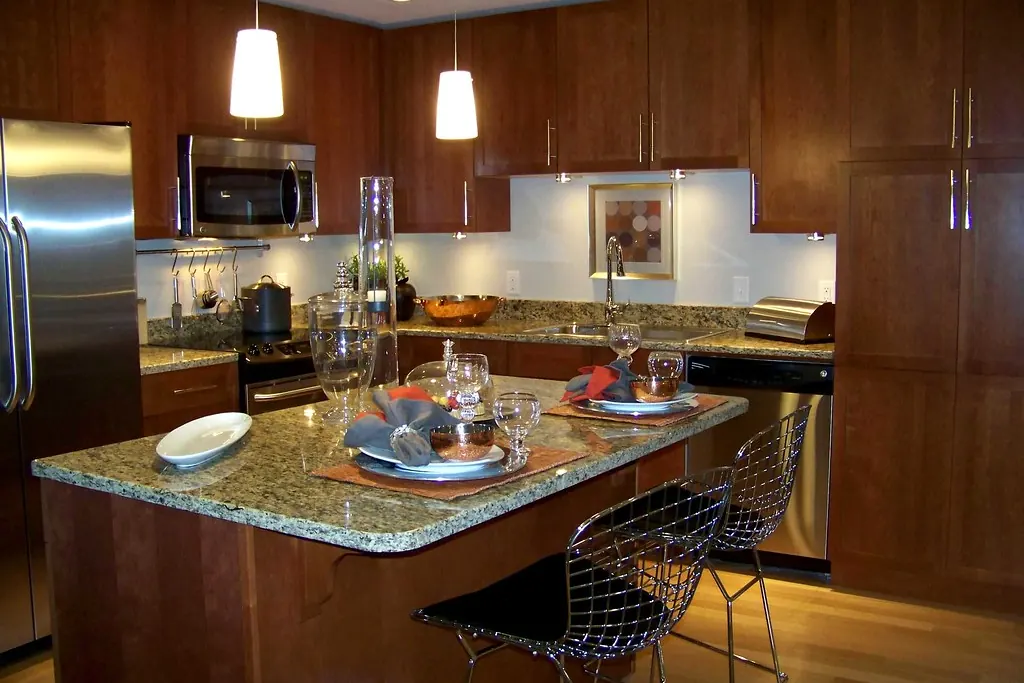
A deliberate contrast is more often the better outcome than people expect. A painted island or a painted butler’s pantry against a stained kitchen is a design decision that reads as intentional, where a near-match reads as a mistake. That is worth considering before committing to the harder route.
The one place the 1978 line helps rather than hurts
Almost every other page on this site has to raise the federal Renovation, Repair and Painting Rule, because San Clemente incorporated on 27 February 1928 and most of its housing predates 1978. Talega is the exception.
The rule applies to “houses, apartments and child-occupied facilities (such as schools and child care centers) built before 1978” and requires that “Anyone who is paid to perform work that disturbs paint in housing and child-occupied facilities built before 1978 must be certified.” The EPA lists, among the categories not covered, “Housing built in 1978 or later.”
In practice that removes a whole class of constraint from work in the newest Specific Plan areas: no certification requirement, no containment and cleanup protocol, no paint testing question. It is one of the quiet reasons work in newer housing moves faster, and it is worth knowing so you can tell whether a contractor’s process is appropriate to your house or imported from a different one.
What a competent builder package is, and how to check yours
“Competent builder package” is a phrase this page has used several times, and it is worth making checkable rather than leaving as an impression.
The Kitchen Cabinet Manufacturers Association runs a voluntary certification, ANSI/KCMA A161.1, covering “rigorous tests of their structural strength, drawer and door integrity, and finish durability.” Certified cabinets have “passed 14 rigorous tests, including a 600-pound load test, to simulate a lifetime of use,” and the association reports that “Between 40% and 50% of cabinets fail their first certification attempt.” Certified cabinets are, in its words, “available at every price point, from builder-grade units to high-end, custom designs.”
That last clause is the relevant one for a production-built house. Builder-grade does not mean uncertified, and a great many production packages carry the certification. If your cabinets do, an addition matched to them is being matched to something that was tested. If they do not, that is worth knowing before deciding whether to extend the existing package or to replace a run of it.
| Question | Why it matters for a matched addition |
|---|---|
| Species, identified rather than guessed | The single most common cause of a near-miss match |
| Door profile and overlay, measured | Both reproduce exactly once measured; neither can be inferred from a photograph |
| Box material, at the sink base and elsewhere | Decides whether the existing run is worth extending or worth replacing |
| Whether the package is ANSI/KCMA A161.1 certified | Tells you what it was tested to when new |
| Finish age and how much it has ambered | Determines whether a match, a toned match or a deliberate contrast is realistic |
| Slide type and rating in the existing base run | Decides whether a drawer conversion can reuse the carcass |
All six are answerable at a survey. The fifth is the one that cannot be fixed by effort, which is why a deliberate contrast is so often the better outcome.
Panels, and the rule that applies to any new cabinetry
Any new composite wood panel added to a Talega house has to meet the same published formaldehyde limits as anywhere else in California. The state’s Green Building Standards Code requires that “Hardwood plywood, particleboard and medium density fiberboard composite wood products used on the interior or exterior of the building shall meet the requirements for formaldehyde as specified in ARB’s Air Toxics Control Measure (ATCM) for Composite Wood (17 CCR 93120 et seq.),” with maximum emissions of 0.05 parts per million for hardwood plywood, 0.09 for particleboard, 0.11 for medium density fiberboard and 0.13 for thin MDF, tested to ASTM E1333.
Federally, TSCA Title VI sets matching limits and requires covered products to carry a compliance label certified by an EPA-recognised third party certifier. Solid wood is not a composite wood product and is not labelled under either rule. As everywhere, the stamp is printed on the panel, so asking to see it is a ten second exercise rather than a document request.
What applies in Talega that applies everywhere in San Clemente
Everything the City publishes covers Talega as it covers the rest of the city. Cabinets are exempt from permit under San Clemente Municipal Code 17.04.032, whose building list includes “Painting, papering, tiling, carpeting, cabinets, counter tops and similar finish work.” Any plumbing, electrical or mechanical work attached to an exempt item still needs its own permit, per the same ordinance. And the City has adopted the 2025 California Residential Code as San Clemente Municipal Code 15.22, effective 1 January 2026, described as based on the 2024 International Residential Code as amended by the State and by San Clemente.
The state rules apply equally: a written and signed contract before work starts on anything over $500 under Business and Professions Code 7159, a deposit capped at $1,000 or ten percent of the contract whichever is less under 7159.5, a three business day right to cancel unless the contract was negotiated at the contractor’s place of business, and a CSLB licence, classification C-6 for cabinet, millwork and finish carpentry. All of it is on the permit and licensing guide.
- Identify the existing species properly before anybody quotes a match
- Decide early whether you are matching or deliberately contrasting, because it changes the whole approach
- Price crown to the ceiling as its own line, since it is the most common addition here
- For a bar or butler's pantry with a sink, budget for a plumbing permit alongside exempt cabinetry
- Ask whether a drawer conversion fits inside the existing carcass or needs a rebuild
- Check any homeowners association rules on work hours, access and waste before scheduling
Finishing a matched addition, and why it is the hard part
Matching a builder package comes down to the finish, and the finish is governed by published rules that shape what a shop can put through a gun. San Clemente sits inside the South Coast Air Quality Management District, which lists the city among the incorporated cities in its four-county jurisdiction.
Rule 1136, Wood Products Coatings, adopted 16 September 1983 and most recently amended 5 June 2026, governs shop application and sets 275 grams of VOC per litre for clear and pigmented primers, sealers, undercoats and topcoats, 350 for high-solids stains and 275 for fillers. Rule 1113, Architectural Coatings, amended 5 February 2016, governs on-site application and sets 275 grams per litre for wood coatings, varnish, sanding sealers and lacquer, 250 for interior stains and 100 for wood conditioners.
Why that matters for a matched addition: toning new work to an aged finish is a colour-matching exercise carried out within those limits, using the compliant waterborne systems that dominate finishing in this district. It is genuinely skilled work, and the honest thing a shop can tell you is how close it expects to get rather than that it will be invisible. Ask that question directly, and treat a confident promise of a perfect match on a ten year old clear coat with some caution.
The alternative, which this page has recommended twice already for good reason, is a deliberate contrast: a painted butler’s pantry or bar run against a stained kitchen. That reads as a design decision rather than as a near-miss, and it removes the hardest variable from the job entirely.
The rest of San Clemente and the service area
Across the rest of the city, the homepage sets out the four eras of San Clemente kitchen and what each one needs, and the custom cabinets page covers new work in full. Outside the city limits the service area runs north through Capistrano Beach and Dana Point, and inland to San Juan Capistrano and Laguna Niguel, where the tract-housing pattern is much the same as Talega a couple of decades earlier. Full coverage on the service area page.