Why this page has no week counts in it
Because no published source gives a defensible lead time for custom cabinetry in this market, and a confident-sounding number with nothing behind it is worse than an honest absence. Every other page on this site cites where its figures come from. There is nothing to cite here, so instead of inventing one, this guide does the thing that is actually useful: it names the stages and tells you what sets the length of each, so you can ask a contractor for dates you can hold them to.
That is not evasion. A single total is the least useful thing anybody can give you, because when it slips you cannot tell which part slipped, whose fault it is or what to chase. Seven dated stages give you seven checkpoints.
The seven stages
What actually controls each stage
| Stage | Controlled by | Can you influence it? |
|---|---|---|
| Measured survey | Scheduling | Yes, by being available |
| Design and approval | Your decision speed | Entirely yours |
| Contract and deposit | Statute and signing logistics | Partly; the cancellation window is fixed |
| Material ordering | Supplier lead times for what you specified | Yes, by choosing stocked items |
| Shop build | The shop's existing queue | No, but you can ask about it before signing |
| Finishing | Coats and cure time | No; rushing it damages the result |
| Install, countertop, snag | Your countertop fabricator's template window | Partly, by choosing the fabricator early |
Four of the seven are not in the cabinet maker's hands, which is the honest reason a single total is so hard to give. Two of them are entirely in yours.
The countertop gap, explained properly
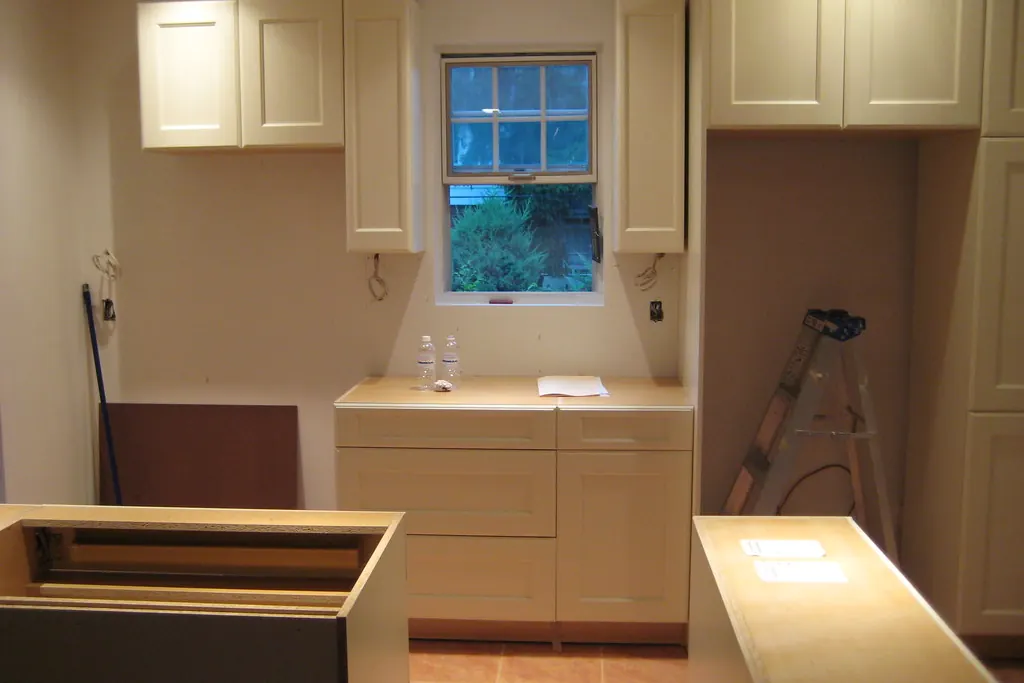
A stone countertop is templated after the cabinets are installed and level, and it cannot be templated before. The template is taken off the boxes that are actually there, because a quarter inch of difference between a drawing and reality is a top that does not fit. Then the slab is cut, edged and polished, and then it is fitted.
The consequence is a real period during which you have cabinets, no worktop and no sink. It is entirely normal, it is unavoidable with natural stone or engineered quartz, and it is the single most common scheduling surprise in a kitchen project because nobody is warned about it at the point they choose the material.
Three practical responses. Choose the countertop supplier early and get their template-to-fit window in writing at that point, not later. Plan your temporary kitchen arrangement to cover that window rather than only the installation. And if the gap is unacceptable, ask about materials that do not need templating, which is a genuine trade-off rather than a trick.
Where the City of San Clemente can affect your schedule
Not on the cabinetry, and potentially on everything attached to it.
The City publishes its own amended exempt-work list as San Clemente Municipal Code 17.04.032, whose building section names “Painting, papering, tiling, carpeting, cabinets, counter tops and similar finish work” as exempt from permit. So the cabinets themselves never wait on the City.
The same ordinance then states: “Unless otherwise provided by this Code, separate plumbing, electrical and mechanical permits will be required for the above-exempted items.” If your job moves a sink, adds circuits, changes a gas connection or fits a new range hood, those permits and their inspections sit inside your schedule.
| Scope item | Permit | Schedule effect |
|---|---|---|
| Cabinets in the same footprint | None | No effect |
| Sink replaced in the same location, same type and size | Generally exempt | No effect |
| Sink moved, or a new island sink | Plumbing | Application, work and inspection inside the schedule |
| Hardwired under-cabinet lighting or a new appliance circuit | Electrical | Same |
| Plug-in low voltage lighting | None; the City's handout says so expressly | No effect |
| New range hood | Mechanical, per the City's handout | Same |
| Removing or relocating a partition to open the room | Building | The largest schedule effect of any item here |
The City states three ways to apply, via its e-Trakit portal, in person during Building Division office hours, or by email with PDFs attached. No plan check turnaround window appears on the City pages read for this guide, so none is stated.
City of San Clemente Permits page, which publishes the ordinance→
The pre-1978 house question, which sits before the schedule rather than inside it
If your house predates 1978 and the work will disturb painted surfaces, a federal rule decides who is allowed to do it, and that is a question to settle before a schedule means anything. The EPA's Renovation, Repair and Painting Rule requires that anyone paid to perform work disturbing painted surfaces in homes built before 1978 be a certified firm, with employees trained either as certified renovators or on the job by one, in lead-safe work practices. EPA administers the programme directly in California, which is not among the states authorised to run their own.
The rule exists because the federal government banned the sale of lead-based paint for homes in 1978, and EPA states that approximately three-quarters of US homes built before that year still contain some lead-based paint. It also notes that friction surfaces, and it names doors specifically, are where old paint produces the chips and dust that become a hazard. A painted cabinet door on old hinges is a friction surface by that description.
| Situation | Does the rule apply |
|---|---|
| Anyone paid to disturb painted surfaces in a pre-1978 home | Yes; the firm must be certified and its workers trained |
| A homeowner doing the work in their own pre-1978 home | Generally no |
| A homeowner who rents out all or part of that home | Yes |
| A homeowner who operates a childcare centre in the home | Yes |
| Somebody who buys, renovates and sells homes for profit | Yes |
| A home built in 1978 or later | No |
Summarised from EPA's Renovation, Repair and Painting Program page. EPA also publishes an emergency provision exempting firms from certain requirements after a disaster.
EPA, Lead Renovation, Repair and Painting Program→
The San Clemente relevance is straightforward. The city was incorporated in 1928 and its own published history names Southwest San Clemente, directly south of downtown, and North Beach, directly north, as the areas holding the oldest housing. A kitchen in either of those, or in any house of that vintage anywhere in the city, is a pre-1978 house for the purposes of this rule. That does not change the stages on this page. It changes who may carry them out, and asking the question at the drawing stage rather than at demolition is the whole of the scheduling advice here.
The three things you control, and they matter most
One: decide quickly at the drawing stage
This is the stage that is entirely yours, and it is where most of the avoidable delay in cabinet projects actually lives. It is also the only stage where changes are free: a change on paper costs nothing and a change after material has been cut costs money and time. Spend the time here deliberately rather than leaking it by indecision.
Two: specify stocked materials unless you have a reason not to
An unusual species, a specific imported hardware line or a non-standard appliance panel will all extend the ordering stage, sometimes considerably. That is a legitimate choice with a known cost attached. What is not useful is making it accidentally, by choosing something at design stage without asking whether it is stocked.
Three: buy the appliances early
Cabinet openings are cut to the actual appliance, not to the category, and a nominal 30 inch range that measures slightly wider across its handles is a real problem discovered late. If the appliances are not chosen, that is a genuine scheduling constraint rather than a detail, and saying so early is better than discovering it at installation. The installation page covers the appliance specification trap in more detail.
How the timeline differs by service
| Service | Stages involved | Countertop gap? |
|---|---|---|
| New custom kitchen | All seven | Yes, if the countertop is being replaced |
| Refacing | Survey, design, contract, order, make doors and skins, fit | No, countertops stay |
| Refinishing | Survey, contract, strip, finish, refit | No |
| Painting | Survey, contract, prep, spray, cure, refit | No |
| Installation only, cabinets supplied | Survey, contract, delivery check, fit | Yes, if new countertops |
| A single built-in or bar run | All seven, at smaller scale | Depends on the top |
The reason refacing, refinishing and painting feel so much faster is not only that there is less work but that the kitchen stays usable for most of it and there is no countertop gap at all.
Sequencing the other trades
A kitchen job is a sequence, and the cabinet install is the hinge in it. Before the cabinets go in, the room has to be stripped and any structural, plumbing rough-in or electrical rough-in work has to be done while the walls are accessible. After the cabinets go in, the countertop is templated and fitted, and only then can the sink and any under-counter appliance be connected.
A common and expensive mistake is booking the plumber and the electrician for a single visit each. Both trades typically need two: a rough-in before the cabinets, and a connection after the countertop. Agreeing that with them at the start rather than discovering it mid-job removes one of the most frequent causes of a kitchen sitting finished-but-unusable for a fortnight.
- Get every stage dated in writing rather than accepting a single total
- Ask which stages depend on somebody other than the cabinet maker
- Choose the countertop supplier early and get their template-to-fit window in writing
- Buy the appliances before openings are cut
- Book the plumber and electrician for two visits each, rough-in and connection
- Decide fast at the drawing stage, because it is free there and expensive afterwards
- If any permitted trade is involved, allow for its application and inspection inside the schedule
- Allow the finish its full cure time before doors are rehung, which is not negotiable with the material
What this guide will not tell you
A number of weeks. Not because it is unknowable in a particular case, but because it is not publishable in general, and this site does not print figures it cannot attribute. What it will say is that a project quoted with dated stages is a project you can manage, and one quoted with a single total is one you can only wait on.
The work itself is on the custom cabinets page, the permits that touch the schedule are in the permit and licensing guide, and if the schedule is the deciding factor, the three-way comparison explains why refacing is so much shorter than replacement.