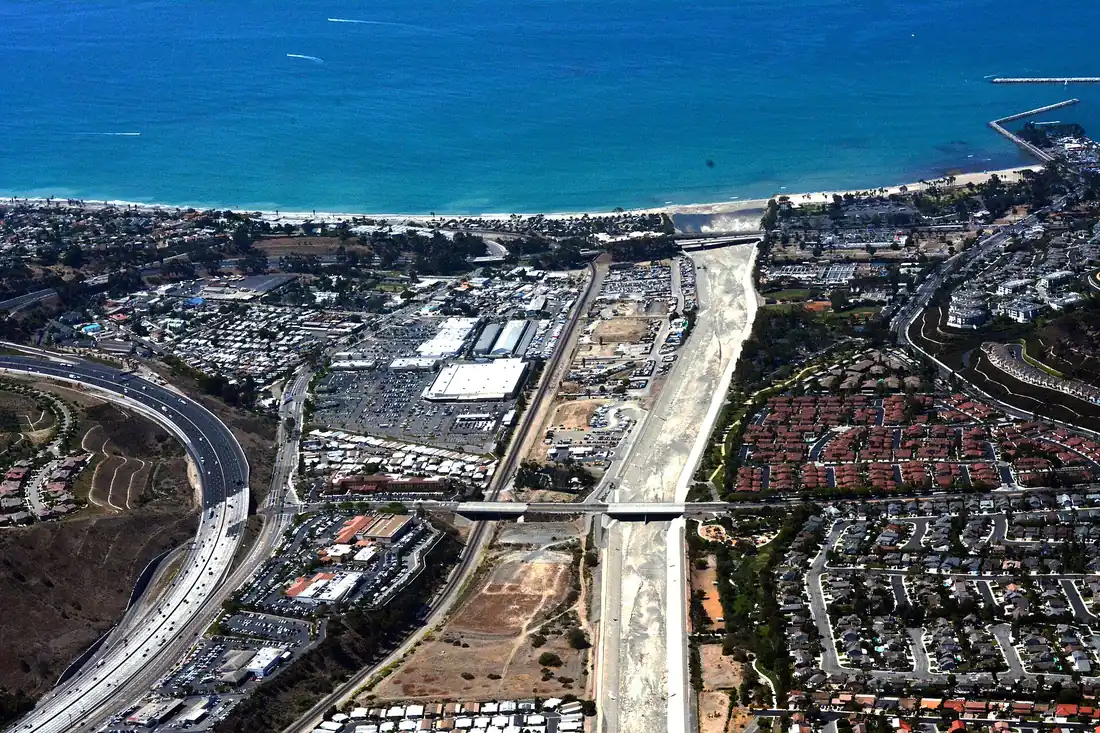
Capistrano Beach, and the houses that make it different
Capistrano Beach is the southern coastal portion of the City of Dana Point, California, carrying ZIP code 92624 and running from Doheny State Beach down towards the San Clemente city line. It is not a separate municipality, so its permits and its city services come through Dana Point, but it has a distinct history and, for anybody building cabinets, a distinct constraint.
That history is worth setting out accurately because it is where the constraint comes from. Edward Doheny’s son Ned formed a development company, the Capistrano Beach Company, together with his wife’s twin brothers Clark and Warren Smith and a contractor named Luther Eldridge, to build a community of Spanish style houses. The historical record is specific about what Eldridge built: “Eldridge favored two dominant characteristics in his homes, a typically Spanish roofline and the use of large ceiling beams in the main rooms of the houses. The roofline, covered with red tiles, incorporated a low-pitched gable, spreading out to one short and one long roof. The ceiling beams were decorated with stenciled artwork painted by artist Alex Meston.”
He completed “the original Doheny family house on the bluffs, four houses on the beach, and 18 other homes scattered throughout the area” before the project collapsed. The unimproved properties reverted to Edward Doheny and, on his death in 1935, to his wife and heirs, and by 1944 all of them had been sold to private parties. So the Eldridge run is roughly two dozen houses, scattered rather than concentrated, among a great deal of later construction.
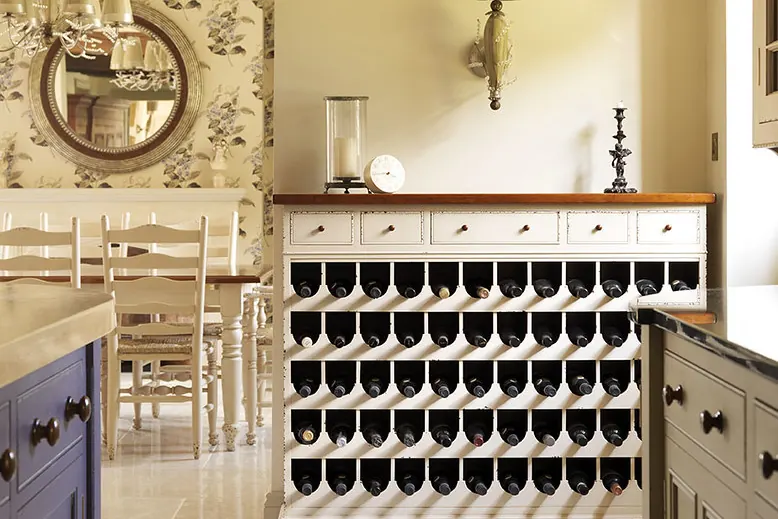
Designing cabinetry for a beamed room
Three practical decisions follow from an exposed beam, and all three are made before anything is cut.
Where the run terminates vertically
A wall cabinet has three options at the top: reach the true ceiling, stop at a beam soffit, or stop below both and accept a gap. The first looks best on walls where it is available. The second is often forced, and it is perfectly good provided the cabinet is designed to finish at that height rather than being a standard-height cabinet with a gap above it. The third is what happens when nobody decided, and it is the dust shelf everybody complains about.
How the crown dies into the beam
If a run carries crown moulding and meets a beam, the crown has to terminate against the beam in a detail that looks intentional. The options are to return the crown into the beam face, to stop it short with a returned end, or to omit crown on that run entirely. All three are legitimate; a crown that simply runs into a beam and stops is not.
What happens to lighting
Beams constrain recessed lighting because there is often structure where a downlight wants to be, which pushes lighting towards under-cabinet fittings, pendants hung clear of the beams, or surface fittings on the beam itself. Under-cabinet lighting is also the point at which a permit-exempt cabinet job acquires an electrical permit, since a new circuit is not finish work.
Older openings, and why custom fits them
Houses from the late 1920s predate standard cabinet dimensions entirely, and the same is true of a good deal of the mid-century construction that followed. Openings are not standard widths, walls are not straight, and floors have had the best part of a century to move.
That is the condition drawn cabinetry exists for. The techniques are the same as in the oldest parts of San Clemente: measure openings at top, middle and bottom rather than once; design scribe allowances into every edge meeting plaster instead of discovering them on install day; and set base cabinets from the highest point of the floor so the run is level rather than following a floor that is not. All of it is on the installation page.
Salt air, and the hardware that survives it
Capistrano Beach is about as exposed as this service area gets: the housing sits between Pacific Coast Highway, the rail corridor and the water, with very little between the front door and the ocean. The component that fails first in that environment is not the timber, the panel or the finish. It is the hardware.
| Material | Behaviour near the water | Verdict |
|---|---|---|
| Chrome or nickel flash over steel | Pits, blisters, then the steel corrodes and the mechanism stiffens | Avoid |
| Unplated or lightly plated steel shelf pins | Rust, then stain the shelf and the carcass | Avoid |
| Solid brass | Patinates and keeps working | Good |
| Stainless steel | Effectively unaffected in this service | Good |
| Properly finished zinc | Durable when the finish is a real coating, not a flash | Good, if specified properly |
This is a specification decision rather than a cost decision, and it is invisible in a quote unless somebody asks for it as a line. Detail on the hardware page.
The same applies with more force to a garage here, which exchanges air with the outside every time the door opens. Garage specification is covered on the garage cabinets page, and hinge, slide and pull selection on the hardware page.
Pre-1978 housing, and the federal rule that follows
Capistrano Beach is one of the oldest pieces of housing stock in this service area. The Eldridge houses date from the late 1920s, the unimproved Doheny properties were not all sold to private parties until 1944, and the later construction around them is overwhelmingly mid-century. Almost none of it postdates 1978.
That makes the federal Renovation, Repair and Painting Rule a routine consideration on cabinet work here rather than an edge case. It applies to “houses, apartments and child-occupied facilities (such as schools and child care centers) built before 1978” and requires that “Anyone who is paid to perform work that disturbs paint in housing and child-occupied facilities built before 1978 must be certified. This includes all firms, even sole proprietorships.” In California the EPA administers it directly. Its covered activities include remodeling, carpentry, plumbing, electrical work and painting preparation.
The exemption is small: “Minor repair and maintenance activities that disturb six square feet or less of paint per room inside, or 20 square feet or less on the exterior,” with window replacement and demolition of painted surfaces covered regardless of area. Stripping out a 1950s kitchen in a painted room is not minor repair. The rule does not apply where a component has been “declared lead-free by a certified inspector or risk assessor,” and the EPA lists three testing routes: EPA-recognised test kits used by certified renovators, X-ray fluorescence instruments used by certified inspectors or risk assessors, and paint chip sampling by any of the three.
What the Housing Element data says about the community this sits in
Capistrano Beach has no housing statistics of its own, because it is a community within the City of Dana Point rather than a separate jurisdiction, and the honest thing to do is say so and then use Dana Point’s numbers with that limitation stated. The SCAG Pre-Certified Local Housing Data prepared for Dana Point’s 6th Cycle Housing Element Update, updated April 2021, is the dataset the City itself used, and it describes a city that is older, more seasonal and more attached-housing-heavy than its neighbours. All three of those traits are more pronounced in Capistrano Beach than in the Dana Point average, not less, which is why the figures are worth reading here even though they cover a wider area than this page.
| Measure | Dana Point | Comparison |
|---|---|---|
| Total housing units | 16,172 | San Clemente 26,573 |
| Single-family detached units | 8,801 | 54.4 percent of all units |
| Single-family attached | 12.8 percent | SCAG region 7.2 percent |
| Multifamily, 2 to 4 units | 16.5 percent | SCAG region 7.5 percent; more than double |
| Multifamily, 5 or more units | 14.7 percent | SCAG region 27.3 percent |
| Occupied units | 14,113 | Total vacancy rate 12.7 percent |
| Share of vacant units that are seasonal | 69.6 percent | SCAG region 33.5 percent |
| Average household size | 2.332 people | San Juan Capistrano 3.052 |
| 2018 median home sales price, existing homes | $940,000 | Up 161 percent since 2000 |
| Housing built before 1980 | 58.5 percent | The reason the federal lead rule is routine here |
Figures from the SCAG Pre-Certified Local Housing Data, updated April 2021, prepared for the City of Dana Point's 6th Cycle Housing Element Update, citing California Department of Finance E-5 estimates and American Community Survey 2014-2018 five year estimates. Capistrano Beach is a community within Dana Point and is not reported separately in that dataset. No figure on this page is presented as a Capistrano Beach statistic.
The age distribution, and why it matters more here than city-wide
Dana Point’s housing peaks hard in the 1970s at 32.1 percent of all units, with another 28.7 percent from the 1980s, 16.6 percent from the 1960s, 7.0 percent from the 1950s, 1.0 percent from the 1940s and 0.8 percent from 1939 and earlier. Only 5.2 percent of the city’s housing was built in 2000 or later. Read that against what is physically in Capistrano Beach and the tail of the distribution is the part that applies: the Luther Eldridge houses of the late 1920s and the cottage stock either side of them sit in the 0.8 and 1.0 percent bands, and the postwar infill sits in the 7.0 and 16.6 percent bands.
The practical reading is that Capistrano Beach is over-represented in the oldest bands of a city that is already old by South Orange County standards. That has three cabinet consequences, each of which is covered elsewhere on this page in its own right. Nothing is square, so every opening is measured rather than one sample door being taken as typical. The federal lead rule applies to essentially all of the original housing here, not to a subset of it. And the building methods vary, because a 1928 house, a 1955 house and a 1978 house in the same few streets were built to three different sets of conventions, so what is behind the plaster is a survey question rather than an assumption.
The seasonal share, which is a specification issue rather than a market one
Dana Point’s 12.7 percent vacancy rate with 69.6 percent of vacant units seasonal works out at roughly 1,430 seasonal units, and Capistrano Beach’s position on the water makes it one of the places that share concentrates. A house closed up from October to May does something specific to cabinetry: with the air conditioning off and the windows shut, interior humidity follows outdoor humidity, so hardware spends the whole off season in damp salt air with nobody opening a door or running an extractor.
That does not change the carcass specification, which is decided by the openings and the beams. It changes the hardware specification, and it changes it in the same direction as the salt exposure this page already describes: solid brass, stainless or properly finished zinc rather than thin decorative plating, on the hinge and the slide as much as on the pull. It also makes the case for keeping any carcass off a slab, because the one thing a closed house does not do is dry out. Both decisions are free at build time and impossible to retrofit, which is the only reason they are worth raising before anything is ordered.
Permits go through Dana Point, and that changes what applies
Capistrano Beach is part of the City of Dana Point, so its building permits are issued by Dana Point rather than by San Clemente. That distinction is worth labouring because San Clemente publishes an unusually detailed set of permit material and none of it applies here.
San Clemente publishes its own amended exempt-work ordinance, San Clemente Municipal Code 17.04.032, a homeowner handout naming which appliances trigger which permit, and its adopted code editions including the 2025 California Residential Code as SCMC 15.22. Those are San Clemente documents governing San Clemente addresses. In Capistrano Beach the process, the fee structure and the application route are Dana Point’s, and should be confirmed with that city.
What holds everywhere in California is the general shape and the state-level protections. Cabinets are finish work; the plumbing, electrical and mechanical work attached to a kitchen is separate. A written, signed contract is required before work starts on anything over $500 under Business and Professions Code 7159. The deposit is capped at $1,000 or ten percent of the contract, whichever is less, under 7159.5. A three business day right to cancel applies, five for a senior citizen, except where the contract was negotiated at the contractor’s place of business. And the CSLB classification to ask for is C-6, Cabinet, Millwork and Finish Carpentry.
Designing around a beamed ceiling, in detail
Section two set out the historical origin of the beams. Here is what they mean at drawing stage, because the answers all have to be settled before anything is cut.
| Condition | Decision | When it has to be made |
|---|---|---|
| A beam crosses above a wall cabinet run | Terminate the run at the beam soffit, or step it | At drawing, because cabinet height is a build dimension |
| A beam meets the wall where crown would run | Return the crown into the beam, or omit crown on that run | At drawing; a crown that just stops looks unresolved |
| A beam crosses above the island | Pendant positions and any overhead rack are set by the beam | At drawing, and it constrains the electrical layout |
| Beams are decorated or stencilled | Nothing is boxed in; cabinetry works around them | At survey, before any design assumes a clean ceiling |
| Recessed lighting wanted where a beam sits | Under-cabinet, surface or pendant lighting instead | At drawing, and new circuits are a permitted trade |
The historical record for the Capistrano Beach Company houses states that the contractor "favored two dominant characteristics in his homes, a typically Spanish roofline and the use of large ceiling beams in the main rooms of the houses," with the beams "decorated with stenciled artwork painted by artist Alex Meston."
The general principle is that a beamed room has two different ceiling heights depending on which way you look, and cabinetry has to acknowledge that rather than average it. A catalogue kitchen cannot; drawn casework can, because a cabinet made two inches shorter to die cleanly into a beam soffit is simply a different number on a cut list.
What we do in Capistrano Beach
All seventeen services on the services hub are available here. Custom cabinetry comes up most, because the older housing and the beamed rooms both defeat catalogue sizing. Built-ins come second, for the same reason: alcoves in these houses are never the same width as each other, which is the classic scribing job. And repair is more common here than elsewhere, because corroded hardware in a house that is otherwise fine is a repair rather than a project.
- Measure the ceiling and any beams as carefully as the walls before anything is drawn
- Decide at drawing stage how crown terminates against a beam, rather than on install day
- Expect non-standard openings and budget for scribe allowances at every plaster edge
- Specify hardware as solid brass, stainless or properly finished zinc, in writing
- Treat the garage as a harsher environment than the house, because it is
- Remember that permits here go through the City of Dana Point, not San Clemente
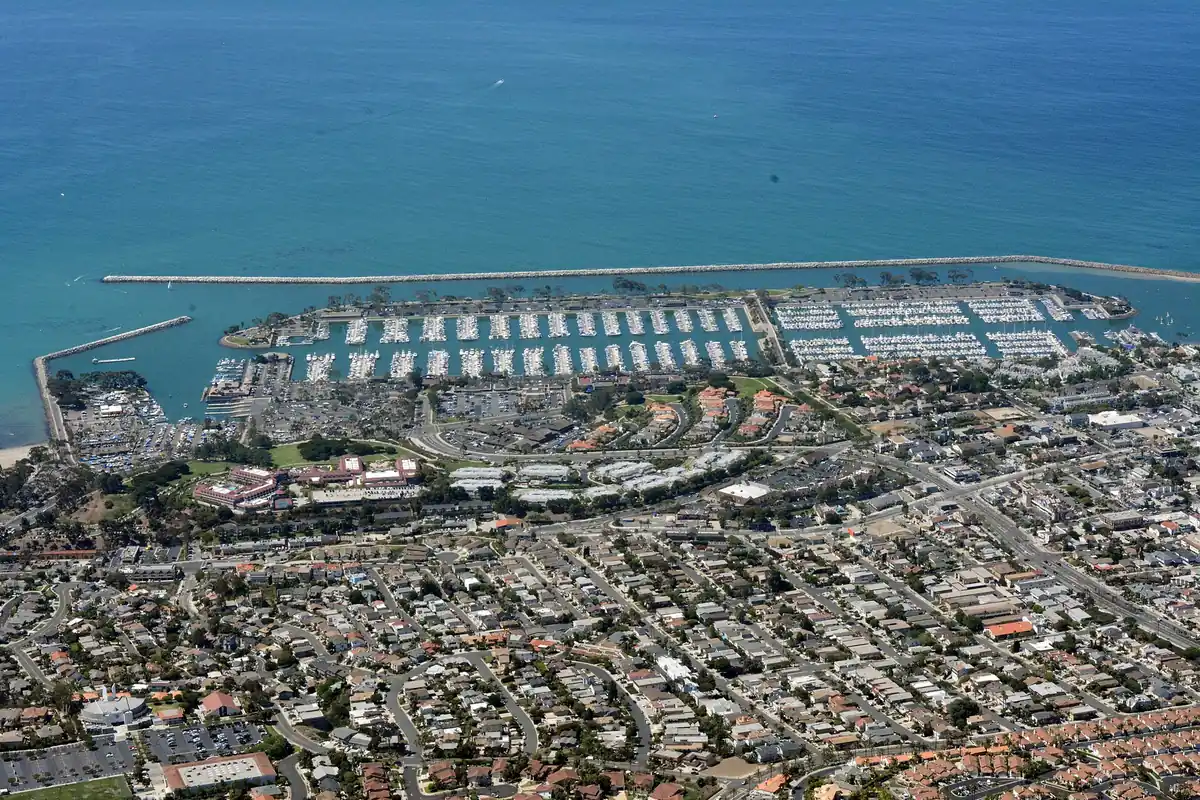
The rest of the service area
North: Dana Point proper, including the Lantern Village, and inland San Juan Capistrano and Laguna Niguel. South across the city line, San Clemente itself, whose oldest housing in North Beach and Southwest San Clemente raises very similar questions, and Talega, which raises the opposite ones. The whole coverage is on the service area page.